Saturday, September 22, 2007
The problem with infrastructure
Tuesday, August 14, 2007
Future foods
Our aim on our small farm was to provide quality veg and fruit for people within walking or cycling distance. It hasn't worked out like that as most people in the village prefer 'choice' offered by supermarkets and they have cars to fulfill their requirements. In the future, it may not be like that. People may suddenly begin to appreciate their local veg farm. Will we be around for long enough for that to happen? The speed at which the world's climate seems to be changing may mean that we could be.
Dig! Dig! Dig! And your muscles will grow big
Keep on pushing the spade
Don’t mind the worms
Just ignore their squirms
And when your back aches laugh with glee
And keep on diggin’
Till we give our foes a Wiggin’
Dig! Dig! Dig! to Victoryfrom HomeSweetHomeFront
Monday, August 06, 2007
Making climate cool
All we like sheep... That's a no-brainer, you'd think. The answer would be the former, wouldn't it? Well actually no, it isn't. A recent survey in the US showed that people were strongly influenced by what they thought other people were doing. This sheep-like desire to follow the crowd overrode any other concerns. Stupid people, you might think, but we all do it, usually unconsciously. That's the whole basis of the giant fashion industry and advertising. We follow the fashions in clothes, hairstyles, cars, holidays or whatever it may be largely because others do too. You remember the old song? ...
Ev'rybody's doin' it
Doin' it, doin' it
Ev'rybody's doin' it
Doin' it, doin' it
Is there a useful lesson to be learned? I think so. We have to somehow make caring about the planet cool. That was the ultimate purpose of Live Earth on 7/7/07 and the reason the celebrities were engaged to perform. Celebs are seen by many to be the ultimate cool; the ultimate trend-setters. So Al Gore's laudable attempt to get them onto a new climate care bandwagon made perfect sense. We need these perceived trendsetters to make climate care cool and to do that, the celebs need to set good examples, something many of them conspicuously don't do. So, celebrities and everyone else, let's do it. Let's make climate cooooool!
Sunday, July 01, 2007
Holidays and gas-guzzlers
Love and marriage, love and marriage
Go together like a horse and carriage
This I tell you brother
You can't have one without the other
Or can you? Maybe the 'horse and carriage' bit hints at an alternative way to have a NoFF holiday!? There are certainly a few brave cyclists who carry all their kit in paniers and manage to survive their holidays. I'm full of admiration for them.
The 'real' world: Back to the 'real' world of motorhome holidays. I have in recent years noted a new trend. Apart from all the 'necessities' like satellite TV and central heating, some motorhomes have a small car attached to the back end, either towed directly or on a trailer (as in the above photo). That can't do anything good for fuel economy either.
Rough wild camping: Words fail me. I feel guilty car camping at all but now that I've reached the age of 60, I find backpacking in places that are generally wet and windy less than pleasurable. But I still do it: I had a week in May in the Scottish Highlands (what I have styled a NoFF week in an earlier post) which was hard work, given rather rough weather and mostly no tracks in my chosen wilderness (west of Bridge of Orchy which offers several high mountains like Stob Gabhar and Stob Coir'an Albannaich, not to mention the cloudmaker, Ben Starav). And yes, I got there by bus and train. I find a week of really 'roughing it' does wonders for making me appreciate all the relative comfort and luxury I have on my small farm in Wales. A hot shower seems like heaven after a week of washing in a billy-full of cold water between rain or sleet squalls. (Yes, it really was like that some days.)
More, more! More comfort and more "boys' toys" playthings (like jet skis) are the trend, it seems, even as the looming tragedy of climate change begins to engulf us: we still deny it's happening and seem to be increasing our energy consumption rather than reducing it. I don't blame anyone for this. Who doesn't like to be warm and comfortable and having fun? But I despair of anyone changing their ways until unpleasant circumstances force a change. We do seem to be trapped. What we enviro people hope for is a voluntary change in attitudes. Meanwhile, the climate-change-is-natural 'deniers' have a lot to answer for in the battle for hearts and minds.
"It's a long way to Tipperary" (in the words of the cheery First World War song) and we really do have "a long way to go".
Monday, May 07, 2007
Condoms combat climate change

Each new UK citizen less means a lifetime carbon dioxide saving of nearly 750 tonnes, a climate impact equivalent to 620 return flights between London and New York*, the Optimum Population Trust says in a new report.
Based on a “social cost” of carbon dioxide of $85 a tonne**, the report estimates the climate cost of each new Briton over their lifetime at roughly £30,000. The lifetime emission costs of the extra 10 million people projected for the UK by 2074 would therefore be over £300 billion. ***
A 35-pence condom, which could avert that £30,000 cost from a single use, thus represents a “spectacular” potential return on investment – around nine million per cent.
The report adds: “The most effective personal climate change strategy is limiting the number of children one has. The most effective national and global climate change strategy is limiting the size of the population.
“Population limitation should therefore be seen as the most cost-effective carbon offsetting strategy available to individuals and nations – a strategy that applies with even more force to developed nations such as the UK because of their higher consumption levels.”
A Population-Based Climate Strategy, the OPT’s latest research briefing, is published today (Monday, May 7 2007). It says human population growth is widely acknowledged as one of the main causes of climate change yet politicians and environmentalists rarely discuss it for fear of causing offence. The result is that a “de facto taboo” exists, throughout civil society and government.
One consequence is that “couples making decisions about family size do so in the belief that it is a matter for them and their personal preferences alone: the public debate and awareness that might have encouraged them to think about the implications of their choices for their fellow citizens, the climate and the wider environment have been missing.”
Other points in the briefing include:
- Providing low-carbon electricity for the 11 million extra UK households forecast for 2050 would mean building seven more Sizewell B nuclear power stations or 10-11,000 wind turbines.
- Global population growth between now and 2050 is equivalent in carbon dioxide emissions terms to the arrival on the planet of nearly two more United States, over two Chinas, 10 Indias or 20 UKs.
- Even if by 2050 the world had managed to achieve a 60 per cent cut in its 1990 emission levels, in line with the Intergovernmental Panel on Climate Change’s recommendations and the UK Government’s target, almost all of it would be cancelled out by population growth.
It concludes: “A population-based [climate] strategy…involves fewer of the taxes, regulations and other limits on personal freedom and mobility now being canvassed in response to climate change…To sum up, it would be easier, quicker, cheaper, freer and greener.”
Valerie Stevens, co-chair of the OPT, said: “We appreciate that asking people to have fewer children is not going to make us popular in some quarters. Equally, expressing concern about the environmental impacts of mass migration, which currently accounts for the bulk of population growth in the UK and will have a major effect on Britain’s carbon emissions, is a quick route to being labelled racist. But these are hugely important issues and the unfortunate fact is that both politicians and the environmental movement are in denial about them. It’s high time we started discussing them like adults and confronting the real challenges of climate change.”
She added: “Government fiscal measures that support child-bearing however many children a couple has, send a signal that increasing numbers are good for the welfare of everyone. In a world needing to diminish its consumption of key resources, especially energy, this is sadly no longer true.”
NOTES
*Based on 1.2 tonnes of carbon dioxide per return flight (Department for Transport).
**Stern Review, October 2006.
***Fertility levels in the UK have been below replacement level (2.1 children per woman) for around 30 years. Inward migration is currently the main driver of UK population growth, accounting for over 80 per cent of projected increase to 2074. However, even without the effects of immigration, demographic momentum – the result of the large numbers of children produced in earlier age bands reaching child-bearing age – would have prevented any population decline up to the present. The total fertility rate (TFR) peaked in 1964 at 2.95 children per woman, but this was followed by a rapid fall in the number of births per woman in the 1970s. In 2005 the TFR in the UK was 1.78 children; it is expected to level off at 1.74 (Office of National Statistics).
The full briefing is available on the OPT’s Briefings and Submissions page.
Sunday, April 22, 2007
Nuclear power: build plants underground
Damage limitation: It is not my purpose here to argue for or against nuclear power or discuss other issues like uranium mining and reserves. It's more of a damage-limitation exercise. Given that reactors will be built whether we like it or not, how can we ensure that they are as safe as possible? Mention the word 'nuclear' to most people, and words like Chernobyl, Hiroshima, missiles, nuclear waste, Windscale and Three Mile Island trip into the mind. Nuclear power has not, over the years, had a good press. And with good reason given its sinister association with bomb-making and several serious accidents. Yet it could easily be made much safer.
Nuclear power hazards: These are well known so I'll just briefly review them. The hazards all stem from the radiation produced by the primary heat-generating fission reaction, spent fuel rods, irradiated reactor assemblies, reprocessing (if any) and the resulting radionuclides which are created in the fissioning of uranium-235 atoms.
- Loss of Coolant Accident (LOCA) in which the fuel rods, normally cooled by water or carbon dioxide gas, become so hot that they melt down (as at Chernobyl)
- Containment damage or breach due to warfare (bombing, missile, suicide using hijacked civil aircraft and so on), accident (aircraft crash), earthquake or climate change events (sea level rise, for example, since many existing plants are located by the sea which is used as a coolant in the secondary circuits)
- Hazards associated with transport of fuel assemblies to and from reactors (attacks, hijacking, accidents)
- Storage of irradiated fuel (attacks, leaks, accidents) in cooling ponds or air-cooled stores
- Reprocessing - the fuel route chosen by the UK and France in particular - which yields highly radioactive acid liquid wastes with potential for explosion in poorly-maintained facilities. Reprocessing notoriously is intended to yield other fissionable products such as plutonium metal, the source for atomic bomb-making and trigger for fusion (hydrogen) bombs. Plutonium, along with enriched uranium (also used for atomic bomb-making), has been repeatedly stolen from former USSR facilities and most of it not tracked down
- Decommissioning costs high and defunct installations will require monitoring and access protection for a century or more
What happens to the long-lived radioactive wastes? The best option at present - far from perfect - is monitored deep burial as vitrified blocks which must be protected from corrosive circulating groundwaters. Unprocessed irradiated fuel rods will likewise need to be stored deep underground (e.g. Yucca Mountain). Radioactive elements such as plutonium-239 in spent fuel will remain hazardous to living things for hundreds of thousands of years.
Scary list, isn't it?
And now, the answer? Almost all of these nuclear hazards become significantly reduced when you factor in a new possibility to the construction equation. If they must be built, why not build these facilities underground? To give you some idea of the relative sizes of the excavations needed, take a look at this drawing I made many years ago for UK examples.
On the left, in my drawing, is a vertical section of the Sizewell B reactor and containment building (click for full size image). On the lower right is an equivalent section through the Dinorwig pumped storage hydropower station, located deep inside a mountain in Snowdonia, beneath defunct slate quarries. For good measure, I added (top right) an as-yet-unbuilt example of another reactor design, a high temperature gas reactor. The point of all is that these engineered structures are all at the same scale: see scale bar.
What's even more important is the size of the Sizewell reactor vessel in relation to everything else. It's small without its containment building. And it wouldn't need such a building underground because being located underground is far better containment than anything that could be built on the surface.
Safety underground: the advantages
- immune to military attack from the air
- containment unbreachable (given proper choice of ground conditions, hydrogeology and rock types) and so immune to attack from, say, a suicide bomber. Even major LOCAs would be better contained than anything above ground
- no need ever to remove irradiated fuel assemblies. When the reactor reaches the end of its operating lifetime, the whole facility could be sealed, complete with its spent fuel. Monitoring would be needed but because nothing is above ground, access would only be minimal
- planning consent more likely to be straightforward since there wouldn't be much surface infrastructure to object to. Most of the usual public fears and objections wouldn't be serious issues
Disadvantages: is there a flip side?
- Cost: I have no idea how much underground siting would add to a budget. But if you take into account minimised decommissioning costs (not historically factored in to the cost of nuclear power as we are now finding out) and spent fuel disposal possibilities, I would guess that it would be completely viable. Anyway, what price security and safety?
- Location: Finding suitable underground conditions, especially in flatter rainy areas with fast-moving groundwater circulation, could be a problem. The ideal would be mountain areas with relatively low rainfall.
- Cooling: Like any steam-driven turbines, cool water is needed both for raising steam and for condensing it. There's no reason for the turbine and cooling systems to be located underground since these aren't in contact with radioactive parts of the circuit
A safe way forward: I've set out what seems to me an obvious way forward for nuclear power, if we are to have much more nuclear electricity as looks certain. (France, by the way, already generates 75% of its electricity this way - but above ground). If you, the reader, agree that making it mandatory to locate future nuclear plants underground is worthy of consideration, please help begin a real debate by contacting your government representative and, perhaps, your country's nuclear generating industry. The onus is on the industry to explain why underground containment is a bad idea, not a good one. If it is a good one, let them start digging!
Wednesday, March 28, 2007
Taboo topic: the population time bomb
What is the Number One Global Problem? In the time it took you to read the previous seven words, the world's population increased by around 5. That's not 5 newborns cancelled out by 5 deaths. That's an overall increase of population which, as I write, is almost 6.6 billion; over three times more than when I was born 60 years ago. Every new person is a consumer of our planetary resources, just as we all are. Some will consume much more than others depending on where they are born and whether their parents are rich or poor. All will contribute in some degree to a grim trio of familiar troubles. The more people there are, the worse they will be:- climate change
- destruction of biodiversity
- pollution
Yet you seldom see much about the population increase. Climate change is the subject of the moment and, in many ways, rightly so. But why do we have to tackle climate change? Because there are so many people. And of course all three issues are tightly interlinked, whilst looming behind them like the spectre at the feast is population increase and the inevitable overconsumption of resources. So biodiversity is being destroyed, partly by climate change but also by the human need for more food (farmland from forest; overfishing etc.). Pollution is caused by people and the gaseous part of it causes climate change. And climate change itself is aggravated by so many people causing fossil fuels to be burned for energy and industrial feedstocks.
Why don't we get serious about population? I suppose the answer must in part be the fear of eugenics. Who gets to have children? Who doesn't? Should they be 'rationed'? Many declare that there is no problem and that the planet can comfortably hold more. Others insist that their religion demands that women produce as many children as possible by forbidding contraception. Some countries, unbelievably, are worried about underpopulation. All these issues - and many similar - are dangerous: people have very strong feelings about what should and should not be done.
There's nothing new here. The problem of population was elucidated far better over 30 years ago [population 4.1 billion]:
The present [1976] population of Latin America [given as an example] is around 300 million [almost 550 million today], and already many of them are under-nourished. But if the population continued to increase at the present rate, it would take less than 500 years to reach the point where the people, packed in a standing position, formed a solid human carpet over the whole area of the continent. This is so, even if we assumed them to be very skinny -- a not-unrealistic assumption. In 1000 years from now, they would be standing on each other's shoulders more than a million deep.
It will not have escaped you that this is a hypothetical calculation! It will not really happen like that for some very good practical reasons. The names of these reasons are famine, plague, and war; or, if we are lucky, birth control. It is no use appealing to advances in agricultural science -- 'green revolutions' and the like [e.g. genetic engineering which has now leaped to the forefront of 'solutions']. Increases in food production may temporarily relieve the problem, but it is mathematically certain that they cannot be a long-term solution; indeed... they may well make the problem worse, by speeding up the rate of population expansion. It is a simple logical truth that, short of mass emigration into space... uncontrolled birth-rates are bound to lead to horribly increased death-rates. It is hard to believe that this simple truth is not understood by those leaders who forbid their followers to use contraceptive methods. They express a preference for 'natural methods' of population limitation, and a natural method is exactly what they are going to get. It is called starvation.
from The Selfish Gene, Richard Dawkins, 1976 p.119.
Full up: The world is full. There's nowhere else to emigrate to for the first time in human history. Humans now occupy the reasonably-habitable parts of every landmass including normally-uninhabitable Antarctica. Not many decades ago, countries like Australia were encouraging immigration and not many decades before that, the USA was accepting the "tired, poor and huddled masses yearning to breathe free" from overcrowded Europe. Not any more. Today, Europe is closing its borders and the US is building a fence to keep migrants out, even though much of their respective agricultural economies depend on low-paid labourforces with no right of residence.
I speak as a former immigrant. In fact, my wife and I have emigrated twice; once to Canada (1970) and, years later, to Spain (1987). In both cases, we were privileged, being educated and not without resources. Even so, the processes were not easy.
The Big Problem: As I see it, the biggest problem we have to solve as soon as possible is not climate change but population growth. If the world's population of humans was small and stable (say a few tens of millions, just to make the point), there wouldn't be a problem with climate change, biodiversity or pollution. There would be an abundance of everything: food, fuel and all the array of natural resources people depend on for their comfort and wellbeing. Those few millions could consume what they liked and they wouldn't begin to cause the problems I mentioned, simply because there wouldn't be enough of them to affect the atmosphere and oceans which control the stability of the world's climate. A small stable population of people would be benign. And they probably wouldn't be constantly warring on one pretext or another, the pretexts we're all familiar with being, generally, land and resources.
But our numbers are not small and not stable. There are nearly 6.6 billion of us, ratcheting up and up in numbers and expectations, and consuming more and more. Because we have failed dismally to even attempt to control our numbers, the result is that we have to tackle not just population growth, but climate change, pollution and biodiversity all at once.
Solutions: The de facto 'natural' solutions are already operating in uncontrolled fashion, mostly affecting the poor:
- diseases like AIDS, tuberculosis and, potentially, bird flu already kill millions
- war and genocides kill millions more (nearly 170 million lives lost to war and major atrocities in the last century)
- starvation
- disasters like hurricanes and droughts
Other more intentional methods of controlling numbers of people have achieved various levels of notoriety:
- one-child-per-couple law in China
- mass sterilisations
- infanticide, apparently widespread in countries where, for various reasons, male children are preferred to female
- abortion
The only widely-acceptable method of control has, of course, been contraception. Unfortunately, some religious groups ban it and because of this influence, the Bush administration of the USA has stopped funding programmes which delivered contraception to those who could most have benefitted from it.
The stark choices: If we do nothing and continue as we are, the planetary mega-ecosystem within which we all live will solve the problem for us -- and it won't be nice for us. Some believe there may not be an 'us' at all within just a few decades, as the planet extinguishes that life which it cannot support.
If we do something, it won't be nice either but has the potential for being rather gentler to a greater number of us than the random and dreadful effects of war, disease and starvation. In short, climate change is a deadly symptom - one of several - of an even more serious malaise. I'm not saying we shouldn't be taking radical steps to tackle the climate problem. We should, but we desperately need to come to terms with the underlying fundamental issue: overpopulation. We need, to paraphrase Winston Churchill, urgent jaw jaw. Otherwise there will be war war ... and more more...
Thursday, March 15, 2007
While the cat's away... Having a NoFF week!
While the cat's away, this mouse ain't having much fun: My wife Val, who's not in the least cat-like, is away for a few days, assisting at my son Mark Lynas's book launch. So it seemed entirely appropriate to conduct a 'climate' experiment on myself.A winter week without fossil fuel: Yes, it's theoretically possible (see my earlier post Have a NoFF Day: NoFF = No Fossil Fuels) and I wanted to find out just how unpleasant it was. I was going to live in a post-carbon world for just 6 days. I turned the oil-fired central heating off at the main switch before Val even walked out of the door to catch her train on Monday, so keen was I. I also vowed that I would not indulge in heat from the wood-burning stove which is nominally carbon-neutral (though I have reservations about this since the trees I have planted around my farm won't sequester what I am burning now for many years to come). We would normally have the stove lit in the evenings at this chilly time of year.
Cold but not that cold: The very first night was quite a test. The skies cleared and the temperature plummeted to 0 degrees Celsius overnight. But I didn't die. I survived quite well by dint of wearing the same night-time clothes in bed (I normally sleep naked) that I wear on my mountain sojourns in Scotland: a base layer on my upper body and Polartec 100 'long johns' on the lower part. The old stone farmhouse has solid uninsulatable walls (something we're hoping to remedy by passive solar means) which buffer the maximum and miniumum outside temperatures so that, without heat input, the inside temperature reflects the average of day and night. This can mean that it's colder in the house during the day - and this has happened several times. Day temperatures did, once, shoot up to 14 Celsius leaving the kitchen at a chilly 10. So the average temperature in the house is probably around 10-11 Celsius.
Watching the telly: Not surprisingly, the body gets coldest when it's not active physically. During the part of the day when I'm outside on the farm, working physically (which includes excavating the foundations for the passive solar conservatory), I'm often hot and the sun shines from time to time. At night, when I relax late in the evening to watch a rented DVD (murder mysteries are my thing this week), I wrap up as warm as I can with as little skin exposed as possible. And with all my layers - the more the better - including a thick fleece and a 'body mitten' blanket thing, I find that I am reasonably comfortable.
Indulgences: No, not the papal sort; the physical sort:
- I boil water - exactly the right amount, measured, for my tea and coffee
- I take an 'instant' hot water electric shower each evening
- I cook my simple meals on an electric hob
- I have lights (low energy, of course) on where I need them
- I use my laptop for several hours (I am an editor for OneClimate.net) and watch TV (LCD screen) for 2 h each day
- I don't drive anywhere because there's plenty of food stored and growing on the farm: vegetables, I mean, not sheep. There's some apples still keeping from last year too
So you can see that my energy demands are extremely low by today's standards. Furthermore, we have reasonably green electricity (RSPB Energy).
T'was ever thus, not long ago: You only have to step back a generation or two to realise that people have always lived like this. Central heating, now completely taken for granted, is an innovation in my lifetime. As a schoolboy aged 10 in chilly Redcar-by-the-sea, I remember ice encrusting the inside of my bedroom window and the stone hotwater bottle my granny gave me to warm the bed. I also remember the misery of the outside toilet. In winter, you would crunch through the snow to get there. Just one small room was heated - a coal fire, and that only for the evening. This is not a complaint; merely an observation. In past times, everyone lived with the cold and dressed accordingly. The notion of heating an entire building was unknown. Not any more. That toughness and reslience has been lost and even cranks like me find it unpleasant to live with almost no energy inputs.
The cat returns: Val returns on Saturday night. The fire is laid ready for her. In fairness, I should add that she, too, has learned to dress appropriately and is to be seen wearing her red hat and thick fleece jacket, body mitten wrapped round her legs, as she does the farm accounts. She, like me, accepts what the IPCC and others are telling us about climate change and about our need to change. She, like me, is doing what she can.
Results: At school, we learned to present our results after conducting experiments (remember? Aim, Method, Results, Conclusions). I'm still continuing my experiment but the results are already clear: it's not fun living without energy. It can be done and may have to be done by many. So I conclude that we need to do our best to reduce energy consumption and to increase renewable energy capacity. We at Mur Crusto farm are well on the way to providing our home with solar heat and, when that's complete, intend to invest some of our savings in a reasonable size (say 5-10 kW) wind turbine. It will be grid-connected and so will earn us money just as effectively as money locked away in investments. And unlike investments which can all come crashing down overnight, our turbine will quietly generate energy and revenue for at least 20 years. Which is the safer option in this unsafe, unstable world which we humans have created? To see what I mean by 'unsafe and unstable', see my son's book: Six Degrees: Our Future on a Hotter Planet, launched tonight!
Saturday, March 10, 2007
Swindled: undermining the fragile consensus
Damaging setback? Channel 4's documentary 'The Great Global Warming Swindle’ has inflicted damage on what looked like the beginnings of a widespread consensus on climate change and upon our taking responsibility for it. This is sad because building such a consensus has taken years and many waverers will have been convinced by this programme's false polemics which appear to give a green light to our understandable desires to continue our energy-extravagant lifestyles.A propaganda gift: George Marshall (COIN) writes: "this programme was a propaganda gift to the various vested interests who seek to undermine the fragile political and social will to take action on this global action. And it was sometimes very convincing, as strongly worded opinions often are when they are not subject to any verification or external challenge." In The Great Channel 4 Swindle, he looks in detail at what was claimed and who was saying it. Some of the names should be well known by now. They are the professional deniers who are skilled at misrepresenting climate science but, as Marshall says, you can "make up your own minds from their track records" which he presents.
Hornswoggled! RealClimate - 'climate science from climate scientists' - offers a detailed critique of the Channel 4 programme titled Swindled! In a post written by two climate modellers, one from the NASA Goddard Institute for Space Studies in New York and the other from the British Antarctic Survey, they (tongue in cheek perhaps) say "We were hoping for important revelations and final proof that we have all been hornswoggled by the climate Illuminati, but it just repeated the usual specious claims we hear all the time. We feel swindled." As one of the many comments on this thorough analysis notes, "yet another tin of red herrings to rebut".
Red herrings and outrage: And if RealClimate isn't enough proof for you, try Campaign against Climate Change (you may need to scroll down the page to see the article). Here, the red herrings get their comeuppance with numerous links to the detailed science behind the issues. As someone asks, what is Channel 4's agenda? Finally, this useful site gives an example of letters of complaint to C4 and Ofcom if you were 'outraged that Channel 4 aired the programme with no caveats'.
Thursday, February 22, 2007
I will if you will...
Singing....I will if you will....so will I
Singing, I will if you will, I will if you will
I will if you will, so will I.
That was the chorus. There were several quite rude verses which we, as schoolboys, sang with gusto on field trips. (Let me see, how did it go? 'Oh she's got a lovely bottom set of teeth.' I'll leave you to work that one out.) Oh, and there's a Scots version which goes 'Oh ye cannae shove yer grannie aff the bus'. Thought you should know that before getting down to the heavy stuff!
What can we do? No, I haven't taken leave of my senses: just trying to inject a little humour into a serious subject: climate change and what we can all do about it. I expect, like me, you're rather tired of reading endless stuff about how serious it all is and how we have to start doing something now. But no-one answers the massively begged question: What exactly do we do? One of our organic veg customers made exactly this point to Val (my wife) a couple of weeks back: We can all see there's trouble ahead but what are we supposed to do? Changing light bulbs and recycling obviously isn't enough. It's up to the politicians, isn't it?
I will if you will: Politicians usually follow where the public leads so we all should have have our say and do our fair share. All of us. That's the point of the song: I will if you will... Most of us are ready to make sacrifices if only we knew that everyone else was doing so too. At present, we see friends flying off on absurdly cheap polluting holidays, driving around in gas-guzzlers, keeping their houses nice and warm with coal and oil, buying food from far and wide so why - the reasonable argument goes - should I be the first to downsize my lifestyle? I will if you will... but you probably won't so why should I?
Practical action: Here's some ideas. Please add more in Comments if you wish.
- Get involved in a climate change network such as OneClimate.net. This sort of environmental social networking site stops you feeling alone and gives you an opportunity to see what others are doing and how they are doing it. It also helps you to start or join a local network or group based on where you live or at your workplace, though it can be as global as you wish. The possibilities for forming such groups of like-minded people are legion. (No doubt we'll have climate change dating agencies soon. Now there's a good idea!)
- Get in touch with your local political representative. Tell them what you think should be happening and what you're prepared to do. WriteToThem.com is a good start for those in the UK if you don't know who your MP is or how to get in touch. Carbon rationing is an idea whose time has come but the politicians need to know there is grassroots support. Try the Carbon Rationing Action Groups for details of how this works and see how inherently fair it is. I will if you will...
- Get together with your neighbours and form a group. You could start off by viewing Al Gore's 'An Inconvenient Truth' which should set things in motion. It's now available on DVD.
- Calculate your carbon footprint. Start by reading It's carbon judgment day by Mark Lynas.
- Get in touch with your local newspaper to tell them about you and your group are doing or plan to do. That could be anything from installing unexciting but essential building insulation (the single most worthwhile thing to do for which there are grants available) to making serious carbon-reduction commitments or pledges. How? Join Cred and make pledges to save carbon.
- If you have kids, remember they're the inheritors of this awful mess we and our forebears have unintentionally made of our planet's atmosphere, ocean and land. It doesn't have to be like this. Think 'out of the box' about your lifestyle. If you come up with any smart ideas, tell everyone in any way that suits you. Al Gore has a small army of people trained to present his 'slide show'. Could you do something like that? There's nothing to beat getting the word across by actual local contacts if you have that kind of charisma! (I don't so I blog instead.)
And me? What am I doing? If all the suggestions about sound a little prescriptive, please note that I really do practice what I preach. I'm typing this with a warm blanket wrapped around my legs, a wooly hat on my head and I'm wearing a thick fleece. It's not too cold today (about 12 degrees C both inside and outside) and I'm confortably warm with no heating. Val, who is a convert to being the change you want to see in the world (thank you Gandhi) like me, wears similar outfits. We travel very little, never fly (obviously or I wouldn't be writing this blog) and I've just asked her if she would calculate our carbon footprint. We do have a very efficient wood-burner for the evenings and use Green electricity and I'm in the process of building a passive solar structure onto the south-facing house front... more on this.
Everybody's doing it, doing it, doing it! Well that's what we'd all like. So let's all sing from the same hymnsheet, eh? Someone has to start the ball rolling so let it be you. Remember the refrain: I will if you will, so will I!
Thursday, February 15, 2007
Happy Birthday! I hope...
Fortunately, my new granddaughter has two of the most wonderful caring parents a child could wish for and she lives in a country which is less likely than many to be badly affected by climate change. So she's a lot better off than most of the kids who were born on her birthnight elsewhere on our planet.
But if she were about ten years old now, she might make this video.
Friday, January 26, 2007
Something in the air: climate change is hot

Top of the Pops: It's part of my job as a freelance climate change editor for OneClimate.net to follow breaking news stories and the latest blog opinion from around the world. So I scan through hundreds of newsfeeds every week and I'm getting a concerted message, loud and clear: climate change issues are top of the agenda just about everywhere, but particularly in North America and, increasingly, China.
The Pigs are flying: Even George W managed to use the phrase 'global climate change' (once) in his lacklustre State of the Union address. ExxonMobil has suddenly become - or has appeared to become - greener, finally pushed by the Union of Concerned Scientists' report into the oil company's covert funding of climate sceptics. Yes, the climate pigs are in the air. The deniers haven't gone away but they're becoming marginalised. It looks like the year things are going to really start to happen. Politicians are picking up the scent and realising not only that many people but also many corporations want them to do something; to legislate. Sir Nicholas Stern has proposed a world carbon tax. Carbon rationing is being talked about as if it might actually happen. On 21 January, Sir David Attenborough presented Climate Change - Britain Under Threat at peak time on BBC television. Al Gore's An Inconvenient Truth is now available free if you haven't seen it. A couple of days ago, BBC2 screened Should I Really Give Up Flying?
"What people (must) do is to change their behaviour and their attitudes. If we do care about our grandchildren then we have to do something, and we have to demand that our governments do something." Sir David Attenborough, BBC.
Is The End Nigh? But will all this frenzy of activity and potential action be enough and in time? Who knows, but we will shortly have a much better idea as the IPCC finalizes its Fourth Assessment Report "Climate Change 2007", due for release on 2 February. Pre-publication syntheses of this report do not make cheerful reading. Just about everything previously predicted is going to be worse than expected and happen sooner. So, as is it is becoming customary to say, when someone has just written such doom-laden words, we've got to change and we have to do it now. I am doing so. How about you?
Friday, January 05, 2007
Spring or winter?
What time of the year is it? It's 5th January, 2007. Today was mild and sunny and look what I found in full flower in one of the hedgerows: it's cow parsley (a member of the carrot family). What's the weather like? It's Wales so we expect gales and rain. And we've had gales and rain most of the time for a couple of months. Normally we'd expect a few frosts by this time of year but so far there have been none here (70 metres above sealevel on a peninsula surrounded by the sea though my farm is 5 kilometres inland).
Wednesday, December 20, 2006
Have a NoFF day
Hypocrisy and honesty: I have actually had a number of NoFF days, partly as a means of
OK, that is cheating, in a sense. Not many of us would want to do that for fun, let alone with the serious intention of trying a day without fossil fuels or living the low-carbon life. But at least you can see that I have honestly had a number of NoFF days so I know whereof I speak - as the cliché goes.
Checklist for a real NoFF day: So let's get real and think. Such a day would need to be as close as you can get to a normal working day. So if you walk to work, that's your NoFF transport taken care of. If it's not too cold or too hot, you don't need any heating at home or at work so that's ok too. If you're one of those who has had the foresight to put their money where their mouth is and use genuinely renewable energy for heating, lighting, cooking and sundries like computers, then you don't need a NoFF day as you're already there!
- Transport: no car? no bus? no plane? No sweat: walk or cycle. If you're so far from work or shops that NoFF is not an option, then consider moving house sometime soon so that it is
. Or what about teleworking? - Heating: no oil, coal or gas heating but you can use electric if it's from a guaranteed renewable source, or wood (wood-burner like mine on the right) which is also renewable and so carbon neutral.
- Cooking: as above, not easy without a range that burns wood. Or biogas if you happen to have it. Or you could use a spirit camping stove like the one I take backpacking. Alcohol fuels can be derived from plant matter and so, like wood, are carbon neutral. An electric stove is fine subject to the power being from a utility company which guarantees its renewability.
- At work: use no machinery or equipment which isn't hand-powered or getting its power from renewables (very unlikely).
- Eating: only locally-grown food or, better, your own-grown food which has zero food miles. If you don't know where your food is from, fossil fuel will have been used to get it to you for sure. If it's packaged and/or processed, fossil fuel will have been used in its manufacture.
It's not easy being green: You'll have read through my list, thought about it a bit, and probably decided that the whole idea is impossible. And to a large extent, you'd be right. You can look upon it as a sort of 'thought experiment'; an exercise in assessing dependence. Or you can give it a go anyway and see how much you can manage. Devise a way to give yourself some points; more points for less FF. What did you score? What was the maximum you could score using your assessment? (If you come up with a good way to do this, add a Comment to this post.)
Points mean prizes! And the eventual prize: a habitable planet for our children to inherit. So... have a NoFF day!
Tuesday, October 24, 2006
Harnessing the power of belief

Some scary facts
- human population is expected to reach 9-10 billion by the end of the century
- the planet is in the middle of its sixth mass extinction
- climate change is the most imminent and serious threat ever faced by humanity
What can we do? Can we mobilise for a War on Climate Change? Most of us opt for outright denial that there's a problem and continue 'business as usual'. Those of us who are aware ('extremists' like myself and still a tiny proportion of humanity) can do very little apart from tinkering round the edges. Politicians can do very little either for fear of unpopularity. Industry in many cases would readily support some action (of course, others like Exxon will not) but are justifiably concerned at being put at a competitive disadvantage in the dog-eat-dog world of modern commerce.
So how do we mobilise the numbers of people we need to get moving on climate change mitigation? In times of world war, whole populations have been successfully mobilised to fight and have had to put up with major adversities (apart from the killing) like rationing: at the very least, there's going to have to be rationing of fossil fuels. But tackling climate change needs international mobilisation, and acceptance - in the rich world at any rate - that living standards will inevitably decline. Is it possible to get started on this before climate-induced disasters impact so severely on economies and lifestyles that there becomes no other option?... but by then, it will be too late because of positive climate feedbacks such as massive methane releases (from gas hydrates in the oceans and vast tracts of melting permafrost in Siberia and Canada which is already underway).
A faith solution: E O Wilson, the great American biologist, already has a partial answer. He's just published a book about it: The Creation: A Meeting of Science and Religion. In it he makes the case for an alliance between secular humanists and people of faith in order to avert mass extinctions.
This approach is not only brilliant; it might also be the best chance we've got. But why stop at American Christians, Wilson's main target audience? Why not all faiths everywhere?
Mobilising religious people: the problem Those old enough to remember songs of the 1960s will probably remember this by mathematician and lyricist Tom Lehrer:
All the Catholics
Hate the Protestants
And the Protestants
Hate the Catholics
All the Muslims hate all the Hindus
And everybody hates the Jews.
National Brotherhood Week, Tom Lehrer
(It was a great tune, too!) But this song serves to make the serious point that so much zeal and potential creativity is diverted into hatred and wars. Much of the news today is about just that.
Have faith and imagine...! If only humankind could harness that often-deadly energy, that zeal, passion and conviction that all faiths share to some degree and channel it into taking action to save our planet! For a start, there'd be much more cash available because there would be less need for armaments, a despicable evil industry which netted more than $1 trillion last year.
I imagine that all the world's great religions include a duty of care of the environment and the planet for the good of all. I know that Buddhists do and American Christians have begun to mobilise on this issue, noticeably over the last few months. Paganism is based on care for Mother Earth as is, for example, the 'old' religion of the Andean peoples who revered pachamama, Mother Earth and inti, the sun god.
How could it come about? It's not going to be easy. I'm sure plenty of people , religious or secular, will have ideas. How about convening an All Faiths Forum where faith leaders agree to bury the hatchet and find common ground? Who convenes it? Over to you, Christians, Muslims, Hindus, Jews: you could work together. Could some of you get started please? Your planet needs you!
If you're religious and you think these ideas are worthwhile, please copy, print and forward this piece to your friends and religious leaders. There's no copyright. My blog is your blog!
Sunday, October 15, 2006
A day at the seaside... without fossil fuel
Have you noticed how, when you drive somewhere reasonably local in your car, it seems an impossible distance to imagine doing on foot or by bike. Yet when you do try it without the car, you're quite surprised at how short a distance it actually is. I have the good fortune to live within a few miles of the nearest sea but oddly, my wife Val and I had never actually tried cycling there instead of using the car... for exactly the reasons I just mentioned: it seemed like a long way to go.
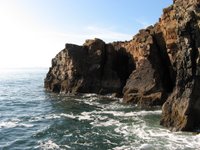
Well we tried it yesterday and - surprise! - it wasn't. Getting there was incredibly easy because it was mostly downhill. Being there was fun as the day was warm and sunny and there were cliffs to explore, beaches for paddling, seabirds and landbirds to see and flowers to enjoy. And, oddly, it was easy cycling home. We had both expected it to be hard.
We have another advantage here in rural north Wales: there's a network of little-used very minor roads. So you can, with care, choose a route which is both scenic and almost devoid of cars. Because it's cars which, for me, make cycling so generally unappealing. On our chosen route, we were passed by one car and only had to cross two main roads.
Happily, many people nowadays can turn to cycling as a means of getting around because there are more and more cycle routes which avoid roads as much as possible. Also, there is something rather special about happy days out in which the only CO2 you add to the atmosphere is from your respiration. Very satisfying!
Monday, October 02, 2006
Who are the 'criminals' really?
'Plane Stupid' protest puts short-haul flights under the spotlight
News from last week suggests that at long last a direct action campaign against climate change is really beginning to kick off. On Sunday 24 September twenty-six 'Plane Stupid' protesters established a temporary climate camp - not in a field next to a power station this time, but on the taxi-way of East Midlands Airport. The airport - called a "climate change factory" by the demonstrators - was chosen because it specialises in mega-polluting short-haul flights, which could easily be replaced by train travel.
Whilst there they listened to a Baptist minister preach from a makeshift pulpit that, at a time when 160,000 people are dying from climate change impacts every year, "flying is a sin". The Rev. Malcolm Caroll's former parish was in nearby Nottingham. The activists managed to stick it out for 4 hours before being removed by police, and all 26 were arrested and charged with aggravated trespass. Needless to say, the real criminals - those operating the airport and the airline companies - continue with business as usual, protected by the full force of the law.
A few days later, the Met Office issues a press release: September was the warmest on record in the United Kingdom "by some margin". Is anyone listening?
I disagree that the 'real criminals' are the plane operators. Of course they are part of the problem. But surely the people to point the finger of blame at are those who actually fill the planes on their cheap package tour holidays. They don't have to do it. They can choose not to. But they don't, either because they don't know what they're doing is crazy or because they don't care. It is the task of we enlightened people who eschew flying for frivolous purposes to - somehow - get through to the 'frequent flyers' and encourage them to take their holidays locally.
Tuesday, August 01, 2006
The climate 'extremist' changes tack
My aim was to encourage like-minded responsible citizens to help make this no-fly stance not 'ex-treme', but mainstream. People who fly for frivolous reasons (like tourism) are killing the future, not just for my kids, but for everyones.
But it's not just air travel that's the problem. It's the way we live on the planet, using far more of its resources than it can possibly sustain whilst the global population ticks away, inching upwards at about 3 per second, and now standing at around 6.6 billion. Refusing to fly for non-essential reasons is just one small thing any of us in the rich world can choose to do which will make an impact once there is a critical mass of likeminded people. There are a host of other things too, some of which I'll doubtless blog about in the future!
Monday, May 22, 2006
Slow is smart
ionship between speed and fuel consumption and now, this is dramatically confirmed by carefully-conducted tests of various models of cars. It doesn't matter whether it's petrol or diesel, gas-guzzling SUV or hybrid, fuel consumption soars as your driving speed goes up.Steer us to diesels: That was the title of a piece I wrote for the Telegraph Magazine many years ago. It made the still-valid point that, mile for mile and size for size, diesel cars are up to 30% more efficient than petrol. Even the so-called 'economical' hybrids still can't touch the best small diesels. I have just about the most economical car on the road - Ford's best kept secret - a diesel Fusion. (See what Green Consumer guide says about its fuel consumption.) Its CO2 emissions are just 116grams per kilometre and I find that it averages around 65mpg/3.6 litres per 100 kilometres. It's surprisingly roomy and more economical than the best hybrid. Why doesn't everyone buy something similar? I got mine second hand a year ago.
Slow down for the planet! So with an economical car AND by driving gently - that's no violent acceleration and braking; keeping to speed limits and cruising at much less than the 70mph speed limit where it applies - you can start making a big difference to your emissions (and bank balance) right away. Oh, and better for the planet too!
Tuesday, May 02, 2006
War on the atmosphere: military aircraft emissions
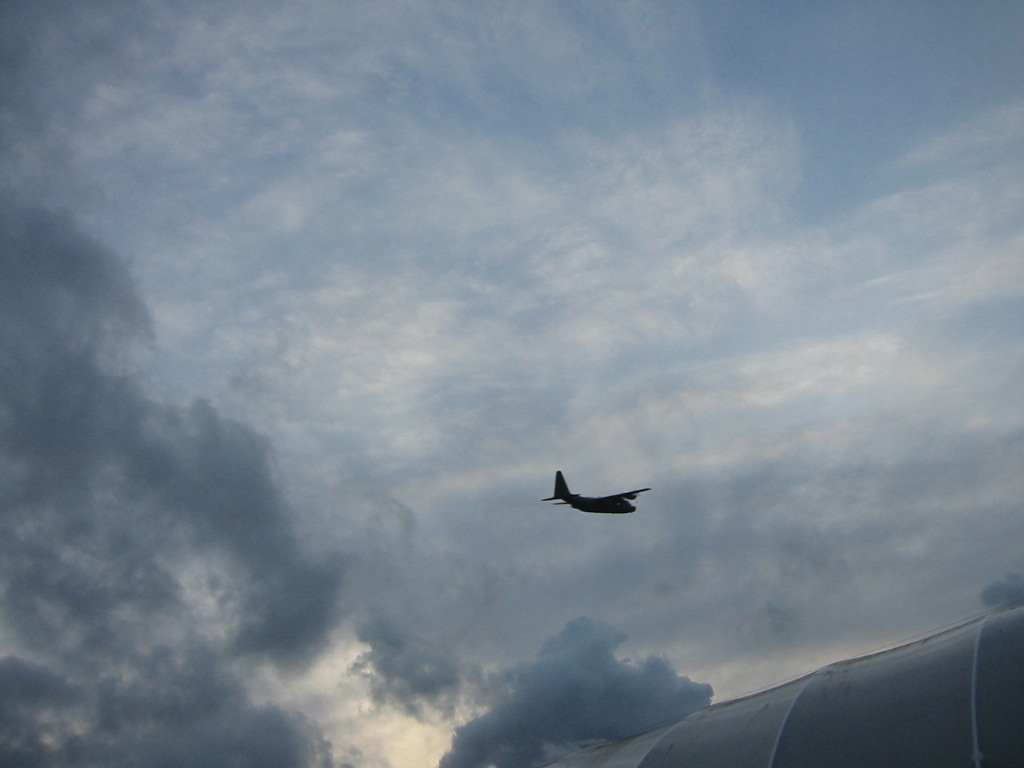
Insult to injury: George Monbiot's recent piece on aircraft emissions prompts this post; something I've been considering for some time. It is, in turn, prompted by the daily screech and roar of military aircraft over this 'peaceful' country haven in north Wales. Quite apart from any other considerations, this daily air and noise pollution is a continual affront to our attempts to live here as sustainably as possible. With one economical car (65mpg average and 116 grams/kilometre CO2 output), a wood-burner, low-energy lights, insulation and central heating used sparingly, our lifestyle is as low carbon as you can reasonably get in the carbon-fuel-dependent UK. Probably these aircraft burn up what we use in a year in just a couple of hours... but I don't know. Who does?... Or is it secret?Aircraft emissions and the atmosphere: Okay, here's the issue: we know aircraft emissions are really bad for the environment, especially those at high altitude. Just how much fuel do the airforces of the world squander on training flights (or war games for big boys and their very expensive toys as I'm uncharitably inclined to regard them after the tenth jet in twenty minutes)? What proportion of total aircraft emissions do they represent? I have no idea but I'll bet it's more than you might think. No doubt it's a closely-guarded military secret. And what's it all for? That gross euphemism 'defence' (Orwell warned of this) is bandied about by politicians everywhere. But what's the point of it all (and upgrading nuclear 'deterrents' come to that)? In what way are these scary warplanes and their undoubtedly skilled pilots increasing our security in Britain? Consider little Costa Rica appropriately about the size of Wales: This little country doesn't have an airforce or any military force. The country is still there... and it has land borders with its neighbours making invasion easy, unlike seabound Britain.
Is war more important than climate? The biggest problem facing the planet now is climate change. Most of us, including politicians, would agree with that. So who is about to attack the UK which requires a large active fuel-burning airforce to repel? Terrorists? But everyone knows that terrorists' weapons are suicide bombers and cars packed with explosives. They don't use aircraft - except as flying bombs, one infamous day, in 2001. So why must we put up with this squandering of limited resources on things like military aircraft and the resultant pollution which endangers everyone, not to mention useless nuclear weaponry? Or is there another agenda we ordinary folk don't hear about, like invading Iran - as if the disaster of the US/UK invasion of Iraq wasn't lesson enough? Or maye it's just successive UK governments' desire to have access to the 'top tables' with their American friends, perpetuating the absurd post-colonial notion of 'punching above our weight' and the so-called 'special relationship' which must be nurtured at all costs? That's a lot of questions but how can I get some answers? I have asked my MP to enquire and he is doing so.
Lives are at stake here.