Showing posts with label nuclear power underground. Show all posts

Tuesday, March 15, 2011

After Fukushima: a way forward for nuclear power?

The post-tsunami disaster at the Fukushima Daiichi nuclear complex in Japan raises critical questions: Can nuclear power ever be completely safe? Should the world - which had been in the process of gearing up to build many more nuclear plants - now abandon them totally? What's the alternative as we strive to reduce consumption of fossil fuels?

Double damage: This is a double disaster,  firstly to Japan and its people (the horrifying drama is still unfolding as I write), and secondly to plans to increase nuclear electricity generation worldwide. Nuclear power is essentially carbon-free and without it, there would be a huge increase in coal-powered generation. Coal is the most polluting of fossil fuels: 1 ton of coal burned produces around 2.8 tons of CO2.

Lessons learned the hard way: What lessons can we learn from Fukushima and earlier nuclear disasters like Chernobyl?
  1. never build reactors near earthquake-prone plate boundaries
  2. never build them in coastal districts known to be vulnerable to tsunamis or rising sealevels
  3. build them with robust containment which can withstand hydrogen explosions, wartime enemy action, aircraft crashes
  4. don't use nuclear fuels which create dangerous and long-lived radioactive waste 
And the solution? Nuclear power is going to be needed in a big way to help us kick some of the fossil fuel habit whilst supporting our energy needs. Which is the lesser evil? Global 'meltdown' due to even more rapid climate change, exacerbated if more coal is burned because nuclear power is abandoned? Or nuclear power?

But supposing there was a way to have our nuclear cake and to eat it. A way which is truly safe and within our grasp right now. There are two fundamental changes which the nuclear industry can adopt to make future nuclear power safe and acceptable. One is a change of fuel and the other a change of containment:
  1. stop using uranium/MOX fuels and replace with thorium: no meltdowns, no bomb-making potential, no enrichment needed, radioactive waste short lived. Thorium reactors were abandoned early on by the nuclear industry during the Cold War because they could not be used for making nuclear weapons (which need enriched U-235 and plutonium)
  2. the containment problem, illustrated horrifically by the Fukushima reactors, can be solved by building all future reactors deep underground. Each reactor should have a large water store above it for passive emergency cooling, employing gravity and not pumps (which failed at Fukushima). The undergound installation, at the end of its design life, can be decommissioned by sealing it complete with its complement of spent thorium fuel whose radioactivity declines in tens of years rather than thousands.
 We all need energy, and much of what we use is electricity. Small but populous nations like Japan and the northern European countries cannot afford to take the risk, no matter how small, of  future Fukushimas or Chernobyls. Adopting the two proposals may be more expensive but consider the enormous cost Japan will have to bear to clean up the mess and build replacement energy-generating capacity. And then there are decommissioning costs...

Suddenly, thorium-fuelled reactors underground look like a technology which, unlike fusion power, is ready and waiting in the wings. Its time has come. How can we make it happen?

................................................................................................

For more on thorium reactors, see Greener Than A Thousand Suns and  Liquid Fluoride Thorium Reactors.

    Saturday, March 14, 2009

    Safe acceptable nuclear power? Here's a way...

    Mephistopheles flying over Wittenberg, in a lithograph by Eugène Delacroix. Image credit: WikipediaUse now; pay later ... a Faustian pact with fossil fuels: Burning fossil fuel the way we do now could almost have been designed to seriously endanger humankind and myriads of other forms of life on this planet. You want climate chaos? Okay, just burn up all that coal, oil and gas as fast as you can and you'll get a climate guaranteed to cause a mass extinction which will likely include humans. Mephistopheles, to mix metaphors, gets his pound of flesh. Suffering and mega-death are part of the fossil fuel package, clearly visible to those who can see beyond the PR smoke of the fossil fuel industry. So can we have our energy cake and eat it too? Yes, if we eschew fossil fuels and look for alternatives.


    Renewable energy gap: I'm enthusiastic about renewable energy. I've built an eco-cottage (massive insulation) and a passive-solar conservatory for heating my stone-built farmhouse. I'm about to install an air-source heat pump and, in a few months, I hope to set about the installation of a grid-connected 6kW Proven wind turbine. I live a simple, low energy life. I travel very little, never fly and burn wood grown on this farm in my woodburning stove . I also plant trees. And my aim? To be carbon neutral.


    Most people can't do many of these sorts of things if they live in towns or cities. They need - and expect to have - electric energy available at the flick of a switch. So do I! So... can renewables like wind and solar power deliver the energy we need? Unfortunately, the answer - for the time being - is no and all the green bluster about solar, wind and waves being able to do it is just naive. In time - by which I mean decades - renewables could and should power the planet when we have built infrastructure like supergrids, vast solar arrays in the Sahara desert and so on. But for now, renewables provide just a few percent of total electric energy used. When the wind doesn't blow and the sun doesn't shine, they're useless. This winter, there have been weeks of cold grey weather without wind. The lights still work because of fossil fuel... and nuclear generation.


    Choices: We all want the lights to work when we need them. Almost every modern gadget and convenience depends utterly on dependable electricity supply. So we have choices to make:
    1. carry on burning fossil fuels like there was no tomorrow... which there won't be
    2. eliminate fossil fuels as soon as possible whilst building up renewable supply systems
    3. build nuclear power stations to replace coal-fired plants as quickly as possible, whilst pursuing renewable generation also as fast as possible (part of the much vaunted Green New Deal which may or may not come to pass)

    Option 1 means disaster and ought to be unacceptable to anyone who cares about the future for their children and the rest of life on our despoiled planet.

    Option 2 means many years of unreliable electricity supply with frequent power cuts. It would work if everyone was prepared to undergo hardship: cold houses, no lights, no TV, no computers for much of the time. But almost everyone would find this unacceptable too

    So we're left with Option 3. Nuclear power stations have been working away, generating reliable baseload power for many years. There have been serious problems and even a disaster or two, but modern designs have good safety records. Unlike coal, they almost never kill people.


    Protests: It goes without saying that any attempt to build new nuclear plants in countries like Britain will result in massive protests. The reasons people protest against nuclear plants are well known and often justified. At the very least, the massive reactor containment structures are eyesores and at the end of the reactor's life will have to remain there for many decades while radiation levels decay sufficiently for dismantling. Then there's proliferation and the unsolved radioactive waste problem. These are genuine causes for concern.

    Protests can and do delay construction, sometimes for years. We haven't got years to cut carbon emissions. So is there a way to make nuclear power more acceptable to people who would otherwise protest? And is there a way to make it even safer than it is now? I think there is...


    Out of sight, out of mind: If you visit Llanberis in North Wales, you'll probably not be aware that there's a major power station there. Where is it? You can't see all the usual structures. The reason is because it is completely underground. So why not take that notion further? Why not build nuclear power plants underground too? The size of excavation needed for a nuclear plant is comparable to the Dinorwig pumped storage power station in Llanberis, as my drawing shows.
    Size comparison between the Sizewell PWR and Dinorwig pumped storage excavations
    Let's consider the advantages that underground construction would offer:

    Advantages

    1. because the containment is unbreachable (given proper choice of ground conditions, hydrogeology and rock types), reactor assemblies would be immune to military attack from the air and also from suicide bombers. Containment above ground could not withstand bunker-busting bombs or small nuclear devices, the latter possibly 'delivered' by suicide vehicle. In our dangerous world, these are possibilities
    2. such unbreachable containment is also immune to accidents, whether external (e.g. crashing airliners) or internal such as major loss of coolant (Three Mile Island) or even Chernobyl-style meltdown disasters. Building robust containment structures above ground is hardly cheap and uses a heck of a lot of greenhouse gas-emitting (in manufacture) steel and cement!
    3. virtually no decomissioning costs: you could more or less just walk away and slam the door. Monitoring would be needed, as for underground nuclear waste repositories, but because nothing irradiated is above ground, access would only need to be minimal. In addition, there would be no need ever to remove irradiated fuel assemblies unless the fuel is to be reprocessed. When the reactor reaches the end of its operating lifetime, the whole facility could be sealed, complete with its spent fuel.
    4. there will be protests at each and every new surface nuclear build with endless public enquiries because of protests. Underground plants would demolish most of the objections. Public acceptance and planning consent should be straightforward since there wouldn't be much surface infrastructure to object to. Most of the usual public fears and objections would cease to be serious issues. It also means that off-the-shelf reactor designs (like the PWRs used throughout France and the most of the USA) could be built even though they might not be as potentially safe as so-called 'fourth generation' reactors, because of the additional safety conferred by underground plants. Waiting for unproven safer designs could lose us another decade.

    Disadvantages

    Cost: I have no idea how much underground siting would add to a budget. But if you take into account minimised decommissioning costs (not historically factored in to the cost of nuclear power as we are now finding out) and spent fuel disposal possibilities, I would guess that it would be completely viable.The economics are only artificially marginal because there's no carbon tax. Anyway, what price security and safety? And if a power utility wanted to re-use as much of the infrastructure as possible at the close of the first reactor's design life, it could just dig another chamber and build its new (improved) reactor next door. Power lines, turbines, transformers etc. all remain to be used again

    So far as I know, no-one has ever tried costing it. As my drawing (above) shows, the actual reactor vessel and primary heat exchangers are really quite small structures because of the high power density which nuclear generation allows. So the chamber would be no larger than many others routinely built for different purposes. The reactor assembly could even be built in a modified abandoned mine (e.g. salt mine). Of course, any such underground site depends on there being a cooling source nearby (river, lake, sea) for condensing steam from the turbines. All the non-radioactive sections of the plant could be above ground to reduce costs.

    Location: Finding suitable underground conditions, especially in flatter rainy areas with fast-moving groundwater circulation, could be a problem. A Llanberis-like site could, in theory, be ideal because the excavations could be made within the steep valley side so that any groundwater would drain out by gravity. And just outside are two deep lakes (see Cooling, below).

    Cooling: Like any steam-driven turbines, cool water is needed both for raising steam and for condensing it. There's no reason for the turbines and cooling systems to be located underground since these aren't in contact with radioactive parts of the circuit. So much of the plant could, like conventional plants, be located by a river or the sea.

    So... if we are to have nuclear fission generation on a larger scale to tide us over until fusion power and renewables come to our rescue, why not build all nuclear plants underground? I think this reasonable question deserves a reasonable answer.

    Further reading: You may like to look at Nuclear power... safe underground and The Future of Nuclear Power, both in this blog series.

    Wednesday, August 20, 2008

    Out of sight but not out of mind: coal v. nuclear

    House on fire: If your house was alight, beginning to burn up all your treasured possessions and imperil the lives of your family inside, you wouldn't attempt to douse it in gasoline, would you? Of course not. You'd use water in an attempt to quell the flames. Yet the gasoline approach seems to be government orthodoxy at present so far as the climate is concerned.


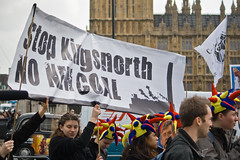
    World on fire: Imagine you were an energy minister and you had been warned repeatedly by thorough science that adding James Hansenmore carbon emissions to the atmosphere was like chucking fuel on the fire of global warming. You can see that authorising more emissions would be guaranteeing life-threatening problems for next generation; our children. So you wouldn't then go ahead and approve a whole new set of electricity-generating plants based on burning that most polluting of fuels, coal, would you? Well actually, yes you would. For that is what many governments are either doing or are about to do. NASA climateKingsnorth power station protests. Image by fotdmike scientist James Hansen has done his utmost to carry his no-more-coal-plants message to many governments, only to be ignored. The climate campers in Britain have done their best to publicise the stupidity of approving new coal-fired power stations, only to be throttled by heavyweight police action clearly authorised directly by a government set on the blinkered short-term view despite all their rhetoric about the need to get out of fossil fuels. It seems to be a case of "Lord make me chaste but not yet". Depressing, isn't it?

    Energy for the future - renewables: Everyone knows what these are by now and campaigning NGOs like Greenpeace and Friends of the Earth have rightly put a lot into getting them adopted into energy plans (whilst vehemently rejecting nuclear). The difficulty with renewables is that they are unreliable. Wind turbines notoriously generate electricity not when we need it but when the wind blows. This means that, overall, they are only generating anything like their rated output for around 25-30% of the time. What happens for the other 70-75%? The hope is that, eventually, all the different forms of renewables (wind, solar, wave, PV, tides) will be linked together via a continent-wide supergrid and employ new means of energy storage. This may work but it is still decades down the line. So we're exhorted to reduce out carbon footprints... and a few of us make valiant attempts to do this. But it's not enough; nowhere near enough. The demand for electricity is bound to increase rapidly as more people travel by the electrically-powered vehicles -trains, buses, cars - which will be replacing hydrocarbon power: petrol/gasoline, diesel and LNG.


    Energy for the future - nuclear: Environmentalists Mark Lynas and George Monbiot have both crossed the rubicon and, albeit reluctantly, adopted James Lovelock's position, rejected by most Greens and set out clearly in The Revenge of Gaia: we have to embrace nuclear power if we are to survive.

    "I have now reached the point at which I no longer care whether or not the answer is nuclear. Let it happen - as long as its total emissions are taken into account..." George Monbiot in The Guardian

    "Increased use of nuclear (an outright competitor to coal as a deliverer of baseload power) is essential to combat climate change..." Mark Lynas in New Statesman.

    Why nuclear? It's that continuity problem; baseload. All grids, to be stable, need to have a good percentage of reliable, continuous generation to which other generating capacity, like pumped storage, can be added at peak times. Coal and nuclear stations are rather well suited to long periods of steady generation, just what renewables can't deliver.


    Nuclear, the lesser of two evils? I know about the dangers of nuclear power. I've had a tour around the UK's Sellafield reprocessing facilities and seen the troubled vitrification plant where the most virulent highly active radioactive waste is made into glass blocks for storage. It's not nice stuff. But it's better than coal as Lovelock has made very clear. Going nuclear, which seems to be about to happen anyway, is the lesser of the two energy-producing evils.

    No time to waste but let's put safety first: Governments need to get on with nuclear build now, not in 5 or 10 years time. 'Fourth generation' inherently safe reactors are not yet beyond prototypes. Even 'off-the-shelf' nuclear plants take some years to build so to make an impact on Big Coal, they have to be built right away instead of coal plants using existing designs. But no-one wants another Chernobyl. Oddly, there is one sure way of making nuclear safe that never seems to get a mention: build the plants - or at least the reactor and primary coolant circuits - underground. The advantages of doing this are pretty obvious when you think about it:

    1. immune to military attack from the air containment unbreachable (given proper choice of ground conditions, hydrogeology and rock types) and so immune to attack from, say, a suicide bomber. Even major accidents would be better contained than anything above ground
    2. no need ever to remove irradiated fuel assemblies.
    3. when the reactor reaches the end of its operating lifetime, the whole facility could be sealed, complete with its spent fuel. Monitoring would be needed but because nothing is above ground, access would only be minimal
    4. planning consent more likely to be straightforward since there wouldn't be much surface infrastructure to object to. Most of the usual public fears and objections wouldn't be serious issues

    You can judge for yourself here.

    Tuesday, October 09, 2007

    The Future of Nuclear Power

    Sizewell nuclear power station: a large footprint (and what about rising sea-levels?) by Rob.Stoke
    Today is the final day for anyone to make their views known about future nuclear power in the UK. I've done this on the British Government's Future of Nuclear Power website. Just to put you in the picture, I have argued for some time that, if we are to have new nuclear power stations, they should be built underground.


    Here are my responses to the Government's consultation questions:


    1. Safety and security of nuclear power


    Siting all future nuclear plants underground is something that should be taken very seriously. This does not even seem to have been considered. Yet it has three major advantages:


    1. immune to military attack from the air

    2. containment unbreachable (given proper choice of ground conditions, hydrogeology and rock types) and so immune to attack from, say, a suicide bomber. Even major LOCAs would be better contained than anything above ground

    3. no need ever to remove irradiated fuel assemblies. When the reactor reaches the end of its operating lifetime, the whole facility could be sealed, complete with its spent fuel. Monitoring would be needed but because nothing is above ground, access would only be minimal. Decommissioning surface plants is turning out to be formidably expensive and all radioactive materials end up having to be sealed underground anyway in all viable scenarios


    2. Transport of nuclear materials: No reprocessing is the right route, but by siting each nuclear plant underground, there would be no need for the spent fuel ever to leave the facility. It would be stored there in a facility built at the same time as the reactor containment cavern. When the reactor's life is over, both it and the spent fuel stored close by would be made safe, sealed and remotely monitored. No radioactive materials, highly active or otherwise, need ever be transported on the surface.


    3. Waste and decommissioning: Locating new reactors underground would avoid many of the serious problems of waste and dceommissioning. At the end of the reactor's life, all its fuel remains in the store which would have been constructed during the initial cavern excavations and the whole underground site becomes a remotely-monitored facility with little further need for maintenance. Such an arrangement is inherently safer than a surface reactor which will need to be guarded and monitored through at least three human generations before it can be finally removed: not a good legacy for future generations.


    4. Environmental impacts of nuclear power: If the nuclear facility was largely located underground, the surface footprint of a site would be markedly less than at present, quite apart from the safety aspect which I've already dealt with. There would be no need for a secondary containment structure since this would be provided by suitably geo-engineered natural rock in the excavated cavern. Surface buildings could all be part of the non-radioactive secondary circuits. So the heat exchangers containing the pipework for the primary circulating coolant would be underground but the high pressure steam circuit for the turbo-generators could be ducted to the surface which is where generators, transformers, cooling and other facilities would be located.


    Regarding the space occupied by a nuclear facility versus that occupied by a windfarm, I have two comments:


    1. most future windfarms should anyway be located offshore, so space and NIMBYism is largely irrelevant

    2. any space occupied by a windfarm remains relatively pristine. If needed, turbines and supports can be completely removed within months, leaving the site uncontaminated and as it was before. The same cannot be said of surface nuclear build because of the massive largely concrete bioshielding infrastructure required and the problem of the 'hot' reactor core which cannot be removed for over 100 years, or requires prohibitively expensive and hazardous remote-controlled decommissioning and transport of large quantities of medium level radioactive waste to a repository as yet not in existence. These 'inconvenient truths' are a prime reason why nuclear build should in future be underground.


    5. Reprocessing of spent fuel: I agree that reprocessing should not be carried out. Storage for spent fuel assemblies should be 'built in' in the underground location scenario I envisage. This eliminates the need for surface transport of highly active fuel rods.

    Obviously these remarks apply to any new nuclear build anywhere on the planet, not just the UK! At the very least, I think the onus should be on governments and the energy industry to explain why siting nuclear plants underground is NOT a good idea (if it isn't!). But I expect it will be ignored... ho hum!