Monday, May 09, 2016
Britsin, not Brexit: why Britain should stick with Europe
Sunday, April 20, 2014
Win win: Energy from (nuclear) waste
| Molten-Salt Reactor Experiment, ORNL |
Sunday, February 23, 2014
Shit, euphemisms and a bear of very little brain
A letter in New Scientist (15 February 2014, p.34) prompted me to write this post, firstly because the use of the word 'poo' gets up my nose (when my children were young, we as a family, used the word shit) and secondly because of Stuart Tallack's aforementioned letter. Since it is not preserved in the magazine's online archive, I reproduce part of it here. Indeed, it could have been written by me:
I am not 5 years old and so don't need the prissy and childish word "poo" to assault my eyes. Excreta, faeces or droppings are perfectly acceptable; dung is perhaps not, as it implies manure. Shit was originally used without any connotation of vulgarity and should re-enter respectable society. But please, not "poo". What next? Articles on genitalia using such euphemisms as "front bottom", "naughty bits" and "meat and two veg"?
Thank you, Stuart! It needed saying. Now I'm off for a shit... and maybe I'll read one of my favourite Pooh stories while I sit on the bog (throne, john etc.). Got that?
Tuesday, February 26, 2013
Waste not, want not: nuclear fuel recycling
| Prototype for the Integral Fast Reactor |
Yet there is a solution available: PRISM reactors, based on the proven passively-safe Integral Fast Reactor. These can 'burn' plutonium (the UK has 100 tonnes), actinides, and depleted uranium (UK has 35,000 tonnes). IFRs are highly efficient and versatile, burning almost all their fuel. By contrast, a Light Water Reactor (e.g. Sizewell B) uses 0.65 per cent of the energy in the original uranium ore resulting in the radioactive waste, currently such a headache. The waste produced by IFRs is about 1/20th of that from an LWR. Its radioactivity within 200 years is about the same as mined uranium ore so no long-term repository is necessary.
David MacKay, chief scientist at the Department of Energy and Climate Change, says that there is enough energy in the UK's waste stockpile to power the country for more than 500 years. So why are we still obsessed with repositories? Why not use the 'waste' to make vast amounts of carbon-free electricity, simultaneously destroying almost all the 'nasties'?
Friday, January 25, 2013
Organics versus GM: throwing the baby out with the bathwater
I have been growing organic fruit and vegetables on and off in several different countries in the world all my life, albeit in a small way. For the last 12 years, my wife and I have been growing commercially for a small box scheme, certified by the Soil Association (one of the several UK organic licensing bodies). In the 1990s, I was heavily involved in the anti-GM movement, helping organise protests, demonstrations, writing to the press and the supermarkets. I even went on the radio once and had a rant about Monsanto and the big corporations. I also started a website for kids which began with an illustrated guide to genetic engineering. (It's still there now – joined by another seven guides to issues which will be of great importance to the kids who are going to inherit our rather damaged world).
But as the years have passed and as it has become abundantly clear that people are not dying in droves because of GM, I've changed my mind. The famous economist John Maynard Keynes is alleged to have said to a critic who accused him of a U-turn, "When the facts change, I change my mind. What do you do, sir?" I am a scientist by training and so I constantly question and revise my views according to the evidence available. Sadly, the organic movement and other mainstream 'green' organisations remain as intransigent as ever in their views on genetic engineering: they seem to be stuck in a time warp 30 years out of date. Perhaps they, like politicians, don't wish to be seen performing a U-turn despite good reasons for doing so.
Basically, I don't understand why certain types of GM crops can't be approved for use with organic systems. It's hard enough growing organically as it is without constantly shooting yourself in the foot by refusing to move with the times. Let's just take one example. Last year, potato blight struck early in the soggy, damp non-summer. The result was that my potato crop was about a quarter of what it normally is. Yet there is a blight resistant GM potato which has been developed in the public domain. If only I could have used that! But I can't because it's against the organic regulations and even if I wasn't organic, I still wouldn't be able to use it because of all the 'green' protests which have made sure that it never sees the light of day; not for organic growers nor for any conventional growers.
What's so terrible about this potato? Is it Frankenfood? No, it's just an ordinary potato with one gene inserted from a wild potato which happens to show resistance to the dreaded Phytophthera infestans, the fungal late blight which caused the Irish potato famine in the 1840s when over a million people died of starvation. Alarmingly the fungus has begun to reproduce sexually over recent years which makes it much more virulent. It had previously reproduced itself asexually and was relatively easily controlled by spraying fungicides or growing somewhat resistant potato varieties.
So why not embrace this GM potato? The introduced gene comes from the same genus - Solanum - and so is not even transgenic. Why is this potato 'bad' whereas the blight resistant Sárpo potato, bred over many years by conventional means, is good? (I was growing a Sárpo variety and it succumbed to the blight like the others.) Of course, blight resistant GM potatoes, like the Sárpo varieties, will sooner or later be overcome by P. infestans. It's an arms race and this is where GM potatoes can leap ahead because it only takes a year or two to splice blight resistance into the genome and grow the resulting plant. It took the Sarvari family, who developed the Sárpo potatoes, some 40 years of careful selection of resistance traits to produce truly blight resistant varieties. As Pamela Ronald, Professor of Plant Pathology and Chair of the Plant Genomics Program at the University of California, Davis says: "To meet the appetites of the world's population without drastically hurting the environment requires a visionary new approach: combining genetic engineering and organic farming". She and her husband co-authored 'Tomorrow's Table' which, argues Stewart Brand, makes "a persuasive case that, far from contradictory, the merging of genetic engineering and organic farming offers our best shot at truly sustainable agriculture".
I agree. It seems to me that organic farming regulations are throwing the baby out with the bathwater. Of course there's 'bad' GM where the profit motive comes before anything else. That was the origin of RoundupReady soybeans, a first generation GM seed which locked farmers into buying Monsanto's brand of glyphosate herbicide. But there's plenty of publicly-funded GM research which is not-for-profit and genuinely attempting to help all farmers grow food crops which don't require multiple applications of 'chemicals' (conventionally-grown potatoes may need 15 applications of fungicide per year). It is an indication of the success of the 'green' anti-GM movement that nothing GM can be grown in Europe.
I think organic regulations should include carefully-chosen GM varieties, each selected on its merits, properly trialled (and not trashed) and tested. That way, organic growers could lead the way forward to a more sustainable agricultural system which can dispense with many 'chemicals' and give good yields under difficult conditions such as those we experience in 'summer' 2012.
Then there's modifying C3 plants like rice to adopt the more efficient C4 photosynthesis. Why is that not acceptable? It will produce far more rice on the same amount of land. And sooner of later, GM is going to make it possible for non-leguminous major crop plants to form nitrogen-fixing symbioses with Rhizobia bacteria. This would make a huge impact on staple crops such as the grass family (wheat, maize, rice) which provide more than half of all calories eaten by humans. It would counteract the synthetic nitrogen overload which is seriously affecting one of the nine planetary boundaries. Would the anti-GM protesters still trash any trials? Shouldn't organic regulations embrace such development? Properly regulated and monitored, genetic engineering is an incredibly useful tool which could and should be available for all growers. Why not use it?
Tuesday, March 15, 2011
After Fukushima: a way forward for nuclear power?
Double damage: This is a double disaster, firstly to Japan and its people (the horrifying drama is still unfolding as I write), and secondly to plans to increase nuclear electricity generation worldwide. Nuclear power is essentially carbon-free and without it, there would be a huge increase in coal-powered generation. Coal is the most polluting of fossil fuels: 1 ton of coal burned produces around 2.8 tons of CO2.
Lessons learned the hard way: What lessons can we learn from Fukushima and earlier nuclear disasters like Chernobyl?
- never build reactors near earthquake-prone plate boundaries
- never build them in coastal districts known to be vulnerable to tsunamis or rising sealevels
- build them with robust containment which can withstand hydrogen explosions, wartime enemy action, aircraft crashes
- don't use nuclear fuels which create dangerous and long-lived radioactive waste
But supposing there was a way to have our nuclear cake and to eat it. A way which is truly safe and within our grasp right now. There are two fundamental changes which the nuclear industry can adopt to make future nuclear power safe and acceptable. One is a change of fuel and the other a change of containment:
- stop using uranium/MOX fuels and replace with thorium: no meltdowns, no bomb-making potential, no enrichment needed, radioactive waste short lived. Thorium reactors were abandoned early on by the nuclear industry during the Cold War because they could not be used for making nuclear weapons (which need enriched U-235 and plutonium)
- the containment problem, illustrated horrifically by the Fukushima reactors, can be solved by building all future reactors deep underground. Each reactor should have a large water store above it for passive emergency cooling, employing gravity and not pumps (which failed at Fukushima). The undergound installation, at the end of its design life, can be decommissioned by sealing it complete with its complement of spent thorium fuel whose radioactivity declines in tens of years rather than thousands.
Suddenly, thorium-fuelled reactors underground look like a technology which, unlike fusion power, is ready and waiting in the wings. Its time has come. How can we make it happen?
................................................................................................
For more on thorium reactors, see Greener Than A Thousand Suns and Liquid Fluoride Thorium Reactors.
Monday, December 21, 2009
Copenhagen: a brief requiem
Hopenhagen?
Nopenhagen!
Nohope-enhagen :-(
Business as usual.
(But it's still the planet, stupid).
To cheer yourself up, listen to The Now Show's interpretation of what went wrong. Happy Solstice!
Tuesday, October 20, 2009
Planning for the future
Question: which one of the above machines needs planning permission before you can buy and use it?The answer, of course, is the wind turbine. This particular turbine should generate enough electricity in an a year to save more than 7 tonnes of CO2.
The SUV doesn't need planning permission to buy; just a lot of money. Much more than the turbine. It will generate more CO2 each year than the turbine will save. It will also cost much more to buy and to run.
Revised question: which of the above machines should have planning permission before you can buy and use it?
It's a no-brainer and a good example of the cockeyed system we have to change in order to tackle the planet's climate woes and overconsumption. As you might guess, I am in the throes of trying to get planning permission for installing a 6kW turbine on my farm.
Tuesday, September 01, 2009
The science of climate change
'Climate is an angry beast...' Quote by climate scientist Wallace Broecker
Image by Lisa Brewster
Everyone’s heard that the planet’s climate is changing but is it true that the planet is warming? What’s the evidence? If there’s an unusually cold winter, isn’t that evidence of global cooling? Many people are sceptical and a little confused. Is global warming just another scare story put about by green eco-nutters? It’s more comforting to believe that everything’s fine and we can carry on as usual. But an unpalatable truth is that the global economic system depends almost totally on cheap fossil fuels – coal, oil, natural gas – to power industry, transport, modern consumerist lifestyles and provide employment. Taking action to reduce the greenhouse gases (GHGs) - which science says cause climate change - will mean drastically cutting back on using these fuels. There’s trouble ahead. So it is reasonable to question how we know climate change really is happening. Mitigation and adaptation will dramatically change our lifestyles, though not necessarily for the worse. So what really is the evidence for climate change? This 4-minute guide summarises it.
Climate and the weather: There is now a mass of evidence that climate is changing fast. Confusion arises because most people don’t appreciate the difference between weather and climate. A cold winter in north Europe doesn’t mean that the climate is cooling: there’s a lot of natural variation year by year and always has been. Climate is about averaging the weather’s variations around the planet over a number of years and looking for a global trend. And there is a trend: temperatures are increasing. The planet is getting hotter and the rate looks set to accelerate.
The evidence comes from careful observations by scientists from many different disciplines over many years. Many lines of evidence can actually be seen happening:
- Ice sheets and glaciers are melting everywhere and there are many dramatic before and after photos which illustrate this
- The area covered by floating sea ice in the Arctic is reducing rapidly
- Permafrost in the Arctic is melting, releasing methane, a potent greenhouse gas (an example of a dangerous ‘positive’ feedback)
- The lower atmosphere (troposphere) is becoming warmer
- Sea levels and ocean temperatures are rising (see below)
- Species of animals and plants are ‘migrating’ to higher latitudes because their home ranges are becoming too warm for them. Diseases are also expanding their range and affecting crops and trees as well as people
- Coral reefs are being killed by the hotter waters. Corals are not only beautiful to look at, they are nursery grounds to myriads of marine species (and sometimes called ‘the rainforests of the sea’.) The planet needs its corals because they sequester carbon from carbon dioxide (CO2) to build their skeletons out of a hard, white mineral called calcium carbonate so, like trees, they are ‘carbon sinks’
- The oceans are absorbing much of the CO2 but as they do so, they are becoming more acidic. This is affecting all kinds of marine life which build their shells out of calcium carbonate. The mineral dissolves in weak acid so acidification means that corals and shells won’t be able to grow, triggering all kinds of knock-on effects in the marine food chain.
Predicting the future: Global Climate Models Climate scientists have developed computer models to predict future climate. They know these are generally accurate because they can successfully be used to predict known past climate by checking their predictions against actual observations (see below). The models allow scientists to predict how the climate will change over the next few decades and are a cornerstone of periodic updates from the Intergovernmental Panel on Climate Change (IPCC) on global climate change.
How can scientists investigate past climates accurately? One way is to examine drill cores taken from ice sheets like those covering Antarctica and Greenland. Past climates can be reconstructed effectively using the records of former atmosphere composition and precipitation preserved in the ice. What’s more, they can be cross-checked using actual historical records and other ‘proxy’ observations such as tree-rings, isotope analysis and radiometric dating. Importantly, the ice cores contain a record of CO2 levels which are higher now than at any time in the last 700,000 years. One well-known result of using all these different methods to assess past climates is the hockey stick graph in which numerous different lines of evidence broadly agree that temperatures have over recent decades started on a steep upward trend. It is not a uniform upward movement because of complex atmosphere-ocean oscillations, the best-known of which is El Niño.
One prediction made by the computer models is that the Arctic and Antarctic will warm faster than the rest of the world. Evidence is coming in that not only is this happening but, alarmingly, it’s happening even faster than predicted because of positive feedbacks. Other predictions show droughts and desert areas increasing (particularly in Australia) and more violent weather patterns with poor countries particularly vulnerable (especially much of Africa). Tropical forests - normally massive carbon 'sinks' (the trees absorb CO2 from the air and transform it into wood, so locking up the carbon) – are today being logged and burned to make way for farming and biofuel plantations, releasing vast quantities of CO2 into the air. As if that wasn’t enough, the models predict drying and major die-off of the Amazon rainforests and increase in wildfires in these former sanctuaries of biodiversity.
The main concern is that rising global temperatures will trigger ‘tipping points’ where GHG inputs reach a critical level, causing a major climate ‘flip’ which could be extremely hostile to much of life – including humans. We know from the distant past that major climate change events can and do occur. One of these, almost certainly caused by GHGs from stupendous volcanic eruptions, wiped out 90 per cent of life on the planet. This mass extinction event occurred around 250 million years ago and was probably worsened by ‘tipping points’ such as major methane releases from methane clathrates. (Today’s oceans host vast deposits of clathrates.) We know of 5 mass extinctions from the geological record and we are now causing the sixth.
How warming happens: the greenhouse effect If you enter a greenhouse on a sunny day, it’s hot because the sun’s heat is trapped by the glass. Carbon dioxide (and other gases like methane, nitrous oxide and ozone-killer CFCs) are called greenhouse gases because they, like the glass in a greenhouse, trap some of the sun’s heat. Without the greenhouse ‘blanket’, the planet would radiate most of this heat back into space. As more GHGs gush into the atmosphere from power station chimneys, farming and car tailpipes, it’s rather like adding double glazing to the greenhouse: more heat is trapped. Most of this heat is absorbed by the world’s oceans so they, like the air, are getting hotter.
The bathtub effect: Without the greenhouse effect, life on Earth wouldn’t exist. Some GHG are essential to keep the planet habitable, but humans are grossly overdoing it. Imagine a bath (which represents the atmosphere) with the taps full on and gushing water (representing GHGs pouring into the atmosphere). There’s no plug so water is also draining from the plughole (representing carbon ‘sinks’ like the oceans and forests which both naturally absorb CO2). In a stable system, the amount of water coming in is roughly balanced by the amount flowing out: the carbon cycle. But we’ve upset the system by pouring increasing amounts of ‘water’ into the ‘bathtub’ so the tub is filling up and will soon overflow. The ‘carbon sinks’ drain is overwhelmed so the planet heats up. This is well explained by the Bathtub simulator. Before people began to burn fossil-fuel in the 19th century, CO2 levels – even during warm periods - were below 300 parts per million (ppm). During ice ages, they fell to less than 200ppm. Since the industrial revolution, they have risen ever faster, particularly in the last decade and now stand at 387. Actual warming closely mirrors this rise.
Sea level rise: Warmer water expands so sea levels go up. But sea levels also rise because of all the melting glaciers and ice sheets around the world. In fact, the rapid melting of almost all the world’s glaciers is one of the most scary indicators that the climate is warming. Sea levels have been rising by about 2mm each year for the last century but this is predicted to greatly increase, causing large scale flooding of many low lying populated areas. The IPCC in their latest (2007) report predict about half a metre of further sea level rise though more recent research suggests double that amount.
This guide to the scientific evidence for climate change and the predictions science can make is deliberately very brief. It first appeared on OneClimate.net. Below is a list of sources of further information if you want to follow anything up.
The Royal Society has produced this overview of the current state of scientific understanding of climate change to help non-experts better understand some of the debates in this complex area of science.
New Scientist's guide to climate change, global warming and greenhouse gases with many other interesting links and news stories.
‘Understanding and Responding to Climate Change’ Downloadable PDF document from the US National Academies. Excellent guide with clear explanations and many images. A free printed version is also available.
RealClimate Climate science blog written by climate scientists with many useful short guides e.g. ‘Highlight’ (right column, scroll down)
Climate change for kids, explained by OneWorld’s Tiki the Penguin
OneWorld’s guide to climate change exposes the reality that global warming will impact poorer countries harder and sooner than the richer countries which are responsible.
Saturday, March 14, 2009
Safe acceptable nuclear power? Here's a way...
Renewable energy gap: I'm enthusiastic about renewable energy. I've built an eco-cottage (massive insulation) and a passive-solar conservatory for heating my stone-built farmhouse. I'm about to install an air-source heat pump and, in a few months, I hope to set about the installation of a grid-connected 6kW Proven wind turbine. I live a simple, low energy life. I travel very little, never fly and burn wood grown on this farm in my woodburning stove . I also plant trees. And my aim? To be carbon neutral.
Most people can't do many of these sorts of things if they live in towns or cities. They need - and expect to have - electric energy available at the flick of a switch. So do I! So... can renewables like wind and solar power deliver the energy we need? Unfortunately, the answer - for the time being - is no and all the green bluster about solar, wind and waves being able to do it is just naive. In time - by which I mean decades - renewables could and should power the planet when we have built infrastructure like supergrids, vast solar arrays in the Sahara desert and so on. But for now, renewables provide just a few percent of total electric energy used. When the wind doesn't blow and the sun doesn't shine, they're useless. This winter, there have been weeks of cold grey weather without wind. The lights still work because of fossil fuel... and nuclear generation.
Choices: We all want the lights to work when we need them. Almost every modern gadget and convenience depends utterly on dependable electricity supply. So we have choices to make:
- carry on burning fossil fuels like there was no tomorrow... which there won't be
- eliminate fossil fuels as soon as possible whilst building up renewable supply systems
- build nuclear power stations to replace coal-fired plants as quickly as possible, whilst pursuing renewable generation also as fast as possible (part of the much vaunted Green New Deal which may or may not come to pass)
Option 1 means disaster and ought to be unacceptable to anyone who cares about the future for their children and the rest of life on our despoiled planet.
Option 2 means many years of unreliable electricity supply with frequent power cuts. It would work if everyone was prepared to undergo hardship: cold houses, no lights, no TV, no computers for much of the time. But almost everyone would find this unacceptable too
So we're left with Option 3. Nuclear power stations have been working away, generating reliable baseload power for many years. There have been serious problems and even a disaster or two, but modern designs have good safety records. Unlike coal, they almost never kill people.
Protests: It goes without saying that any attempt to build new nuclear plants in countries like Britain will result in massive protests. The reasons people protest against nuclear plants are well known and often justified. At the very least, the massive reactor containment structures are eyesores and at the end of the reactor's life will have to remain there for many decades while radiation levels decay sufficiently for dismantling. Then there's proliferation and the unsolved radioactive waste problem. These are genuine causes for concern.
Protests can and do delay construction, sometimes for years. We haven't got years to cut carbon emissions. So is there a way to make nuclear power more acceptable to people who would otherwise protest? And is there a way to make it even safer than it is now? I think there is...
Out of sight, out of mind: If you visit Llanberis in North Wales, you'll probably not be aware that there's a major power station there. Where is it? You can't see all the usual structures. The reason is because it is completely underground. So why not take that notion further? Why not build nuclear power plants underground too? The size of excavation needed for a nuclear plant is comparable to the Dinorwig pumped storage power station in Llanberis, as my drawing shows.
Let's consider the advantages that underground construction would offer:
Advantages
- because the containment is unbreachable (given proper choice of ground conditions, hydrogeology and rock types), reactor assemblies would be immune to military attack from the air and also from suicide bombers. Containment above ground could not withstand bunker-busting bombs or small nuclear devices, the latter possibly 'delivered' by suicide vehicle. In our dangerous world, these are possibilities
- such unbreachable containment is also immune to accidents, whether external (e.g. crashing airliners) or internal such as major loss of coolant (Three Mile Island) or even Chernobyl-style meltdown disasters. Building robust containment structures above ground is hardly cheap and uses a heck of a lot of greenhouse gas-emitting (in manufacture) steel and cement!
- virtually no decomissioning costs: you could more or less just walk away and slam the door. Monitoring would be needed, as for underground nuclear waste repositories, but because nothing irradiated is above ground, access would only need to be minimal. In addition, there would be no need ever to remove irradiated fuel assemblies unless the fuel is to be reprocessed. When the reactor reaches the end of its operating lifetime, the whole facility could be sealed, complete with its spent fuel.
- there will be protests at each and every new surface nuclear build with endless public enquiries because of protests. Underground plants would demolish most of the objections. Public acceptance and planning consent should be straightforward since there wouldn't be much surface infrastructure to object to. Most of the usual public fears and objections would cease to be serious issues. It also means that off-the-shelf reactor designs (like the PWRs used throughout France and the most of the USA) could be built even though they might not be as potentially safe as so-called 'fourth generation' reactors, because of the additional safety conferred by underground plants. Waiting for unproven safer designs could lose us another decade.
Disadvantages
Cost: I have no idea how much underground siting would add to a budget. But if you take into account minimised decommissioning costs (not historically factored in to the cost of nuclear power as we are now finding out) and spent fuel disposal possibilities, I would guess that it would be completely viable.The economics are only artificially marginal because there's no carbon tax. Anyway, what price security and safety? And if a power utility wanted to re-use as much of the infrastructure as possible at the close of the first reactor's design life, it could just dig another chamber and build its new (improved) reactor next door. Power lines, turbines, transformers etc. all remain to be used again
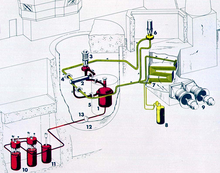
So far as I know, no-one has ever tried costing it. As my drawing (above) shows, the actual reactor vessel and primary heat exchangers are really quite small structures because of the high power density which nuclear generation allows. So the chamber would be no larger than many others routinely built for different purposes. The reactor assembly could even be built in a modified abandoned mine (e.g. salt mine). Of course, any such underground site depends on there being a cooling source nearby (river, lake, sea) for condensing steam from the turbines. All the non-radioactive sections of the plant could be above ground to reduce costs.
Location: Finding suitable underground conditions, especially in flatter rainy areas with fast-moving groundwater circulation, could be a problem. A Llanberis-like site could, in theory, be ideal because the excavations could be made within the steep valley side so that any groundwater would drain out by gravity. And just outside are two deep lakes (see Cooling, below).
Cooling: Like any steam-driven turbines, cool water is needed both for raising steam and for condensing it. There's no reason for the turbines and cooling systems to be located underground since these aren't in contact with radioactive parts of the circuit. So much of the plant could, like conventional plants, be located by a river or the sea.
So... if we are to have nuclear fission generation on a larger scale to tide us over until fusion power and renewables come to our rescue, why not build all nuclear plants underground? I think this reasonable question deserves a reasonable answer.
Further reading: You may like to look at Nuclear power... safe underground and The Future of Nuclear Power, both in this blog series.
Tuesday, March 10, 2009
Four-minute guide to the science of climate change
Climate and the weather: There is now a mass of evidence that climate is changing fast. Confusion arises because most people don’t appreciate the difference between weather and climate. A cold winter in north Europe doesn’t mean that the climate is cooling: there’s a lot of natural variation year by year and always has been. Climate is about averaging the weather’s variations around the planet over a number of years and looking for a global trend. And there is a trend: temperatures are increasing. The planet is getting hotter and the rate looks set to accelerate.
The evidence comes from careful observations by scientists from many different disciplines over many years. Many lines of evidence can actually be seen happening:
- Ice sheets and glaciers are melting everywhere and there are many dramatic before and after photos which illustrate this
- The area covered by floating sea ice in the Arctic is reducing rapidly
- Permafrost in the Arctic is melting, releasing methane, a potent greenhouse gas (an example of a dangerous ‘positive’ feedback)
- The lower atmosphere (troposphere) is becoming warmer
- Sea levels and ocean temperatures are rising (see below)
- Species of animals and plants are ‘migrating’ to higher latitudes because their home ranges are becoming too warm for them. Diseases are also expanding their range and affecting crops and trees as well as people
- Coral reefs are being killed by the hotter waters. Corals are not only beautiful to look at, they are nursery grounds to myriads of marine species (and sometimes called ‘the rainforests of the sea’.) The planet needs its corals because they sequester carbon from carbon dioxide (CO2) to build their skeletons out of a hard, white mineral called calcium carbonate so, like trees, they are ‘carbon sinks’
- The oceans are absorbing much of the CO2 but as they do so, they are becoming more acidic. This is affecting all kinds of marine life which build their shells out of calcium carbonate. The mineral dissolves in weak acid so acidification means that corals and shells won’t be able to grow, triggering all kinds of knock-on effects in the marine food chain.
How can scientists investigate past climates accurately? One way is to examine drill cores taken from ice sheets like those covering Antarctica and Greenland. Past climates can be reconstructed effectively using the records of former atmosphere composition and precipitation preserved in the ice. What’s more, they can be cross-checked using actual historical records and other ‘proxy’ observations such as tree-rings, isotope analysis and radiometric dating. Importantly, the ice cores contain a record of CO2 levels which are higher now than at any time in the last 700,000 years. One well-known result of using all these different methods to assess past climates is the hockey stick graph in which numerous different lines of evidence broadly agree that temperatures have over recent decades started on a steep upward trend. It is not a uniform upward movement because of complex atmosphere-ocean oscillations, the best-known of which is El Niño.
One prediction made by the computer models is that the Arctic and Antarctic will warm faster than the rest of the world. Evidence is coming in that not only is this happening but, alarmingly, it’s happening even faster than predicted because of positive feedbacks. Other predictions show droughts and desert areas increasing (particularly in Australia) and more violent weather patterns with poor countries particularly vulnerable (especially much of Africa). Tropical forests - normally massive carbon 'sinks' (the trees absorb CO2 from the air and transform it into wood, so locking up the carbon) – are today being logged and burned to make way for farming and biofuel plantations, releasing vast quantities of CO2 into the air. As if that wasn’t enough, the models predict drying and major die-off of the Amazon rainforests and increase in wildfires in these former sanctuaries of biodiversity.
The main concern is that rising global temperatures will trigger ‘tipping points’ where GHG inputs reach a critical level, causing a major climate ‘flip’ which could be extremely hostile to much of life – including humans. We know from the distant past that major climate change events can and do occur. One of these, almost certainly caused by GHGs from stupendous volcanic eruptions, wiped out 90 per cent of life on the planet. This mass extinction event occurred around 250 million years ago and was probably worsened by ‘tipping points’ such as major methane releases from methane clathrates. (Today’s oceans host vast deposits of clathrates.) We know of 5 mass extinctions from the geological record and we are now causing the sixth.
How warming happens: the greenhouse effect If you enter a greenhouse on a sunny day, it’s hot because the sun’s heat is trapped by the glass. Carbon dioxide (and other gases like methane, nitrous oxide and ozone-killer CFCs) are called greenhouse gases because they, like the glass in a greenhouse, trap some of the sun’s heat. Without the greenhouse ‘blanket’, the planet would radiate most of this heat back into space. As more GHGs gush into the atmosphere from power station chimneys, farming and car tailpipes, it’s rather like adding double glazing to the greenhouse: more heat is trapped. Most of this heat is absorbed by the world’s oceans so they, like the air, are getting hotter.
The bathtub effect: Without the greenhouse effect, life on Earth wouldn’t exist. Some GHGs are essential to keep the planet habitable, but humans are grossly overdoing it. Imagine a bath (which represents the atmosphere) with the taps full on and gushing water (representing GHGs pouring into the atmosphere). There’s no plug so water is also draining from the plughole (representing carbon ‘sinks’ like the oceans and forests which both naturally absorb CO2). In a stable system, the amount of water coming in is roughly balanced by the amount flowing out: the carbon cycle. But we’ve upset the system by pouring increasing amounts of ‘water’ into the ‘bathtub’ so the tub is filling up and will soon overflow. The ‘carbon sinks’ drain is overwhelmed so the planet heats up. This is well explained by the Bathtub simulator. Before people began to burn fossil-fuel in the 19th century, CO2 levels – even during warm periods - were below 300 parts per million (ppm). During ice ages, they fell to less than 200ppm. Since the industrial revolution, they have risen ever faster, particularly in the last decade and now stand at 387. Actual warming closely mirrors this rise.
Sea level rise: Warmer water expands so sea levels go up. But sea levels also rise because of all the melting glaciers and ice sheets around the world. In fact, the rapid melting of almost all the world’s glaciers is one of the most scary indicators that the climate is warming. Sea levels have been rising by about 2mm each year for the last century but this is predicted to greatly increase, causing large scale flooding of many low lying populated areas. The IPCC in their latest (2007) report predict about half a metre of further sea level rise though more recent research suggests double that amount.
This guide to the scientific evidence for climate change and the predictions science can make is deliberately very brief. Below is a list of sources of further information if you want to follow anything up.
The Royal Society has produced this overview of the current state of scientific understanding of climate change to help non-experts better understand some of the debates in this complex area of science.
New Scientist's guide to climate change, global warming and greenhouse gases with many other interesting links and news stories.
‘Understanding and Responding to Climate Change’ Downloadable PDF document from the US National Academies. Excellent guide with clear explanations and many images. A free printed version is also available.
RealClimate Climate science blog written by climate scientists with many useful short guides e.g. ‘Highlight’ (right column, scroll down)
Climate change for kids, explained by OneWorld’s Tiki the Penguin
OneWorld’s guide to climate change exposes the reality that global warming will impact poorer countries harder and sooner than the richer countries which are responsible.
Thursday, November 06, 2008
Plus ça change...
Green opportunity or TNT? Dammit, when will these people ever get it? They are totally stuck in the cramped vertical thinking of what they like to call the 'real world economy'. They're not fools, they're not stupid; just stuck. They can't see any alternative to laissez faire capitalism which has spectacularly failed. Right now, we really have the chance to dump 'business as usual', aka 'Trashing the planet with No Thought of tomorrow' or TNT, an ulimately explosive notion. Yet here, now, we have a global recession and a new American president who takes climate change and renewables seriously. Here, now, we have a chance to restructure, to dump the loony concept of eternal growth and start to build a steady-state sustainable economy which accepted that people and their business depend utterly on the biosphere. It IS the planet, stupid!
And the planet is very sick. It needs a big dose of Franklin D Roosevelt and John Maynard Keynes' medicine to make a change actually happen. So will people who are in a position to do something open their minds to the realities of impending biosphere collapse and the notion that there could be viable alternatives to rampant consumerist capitalism? President-Elect Barack Obama could be the catalyst but the pessimist in me says that inertia, denial, greed and fear of change will ensure the TNT approach will win out. I earnestly hope I'm wrong.
Monday, October 06, 2008
To hell with it!
We're doomed! This is the half-joking message which I'm getting from friends and colleagues. The climate change scenario is so big and so scary that we might as well eat, drink and be merry, for tomorrow, we die.Wednesday, August 20, 2008
Out of sight but not out of mind: coal v. nuclear
World on fire: Imagine you were an energy minister and you had been warned repeatedly by thorough science that adding
more carbon emissions to the atmosphere was like chucking fuel on the fire of global warming. You can see that authorising more emissions would be guaranteeing life-threatening problems for next generation; our children. So you wouldn't then go ahead and approve a whole new set of electricity-generating plants based on burning that most polluting of fuels, coal, would you? Well actually, yes you would. For that is what many governments are either doing or are about to do. NASA climate
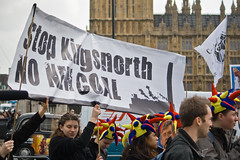
scientist James Hansen has done his utmost to carry his no-more-coal-plants message to many governments, only to be ignored. The climate campers in Britain have done their best to publicise the stupidity of approving new coal-fired power stations, only to be throttled by heavyweight police action clearly authorised directly by a government set on the blinkered short-term view despite all their rhetoric about the need to get out of fossil fuels. It seems to be a case of "Lord make me chaste but not yet". Depressing, isn't it?
Energy for the future - renewables: Everyone knows what these are by now and campaigning NGOs like Greenpeace and Friends of the Earth have rightly put a lot into getting them adopted into energy plans (whilst vehemently rejecting nuclear). The difficulty with renewables is that they are unreliable. Wind turbines notoriously generate electricity not when we need it but when the wind blows. This means that, overall, they are only generating anything like their rated output for around 25-30% of the time. What happens for the other 70-75%? The hope is that, eventually, all the different forms of renewables (wind, solar, wave, PV, tides) will be linked together via a continent-wide supergrid and employ new means of energy storage. This may work but it is still decades down the line. So we're exhorted to reduce out carbon footprints... and a few of us make valiant attempts to do this. But it's not enough; nowhere near enough. The demand for electricity is bound to increase rapidly as more people travel by the electrically-powered vehicles -trains, buses, cars - which will be replacing hydrocarbon power: petrol/gasoline, diesel and LNG.
Energy for the future - nuclear: Environmentalists Mark Lynas and George Monbiot have both crossed the rubicon and, albeit reluctantly, adopted James Lovelock's position, rejected by most Greens and set out clearly in The Revenge of Gaia: we have to embrace nuclear power if we are to survive.
"I have now reached the point at which I no longer care whether or not the answer is nuclear. Let it happen - as long as its total emissions are taken into account..." George Monbiot in The Guardian
"Increased use of nuclear (an outright competitor to coal as a deliverer of baseload power) is essential to combat climate change..." Mark Lynas in New Statesman.
Why nuclear? It's that continuity problem; baseload. All grids, to be stable, need to have a good percentage of reliable, continuous generation to which other generating capacity, like pumped storage, can be added at peak times. Coal and nuclear stations are rather well suited to long periods of steady generation, just what renewables can't deliver.
Nuclear, the lesser of two evils? I know about the dangers of nuclear power. I've had a tour around the UK's Sellafield reprocessing facilities and seen the troubled vitrification plant where the most virulent highly active radioactive waste is made into glass blocks for storage. It's not nice stuff. But it's better than coal as Lovelock has made very clear. Going nuclear, which seems to be about to happen anyway, is the lesser of the two energy-producing evils.
No time to waste but let's put safety first: Governments need to get on with nuclear build now, not in 5 or 10 years time. 'Fourth generation' inherently safe reactors are not yet beyond prototypes. Even 'off-the-shelf' nuclear plants take some years to build so to make an impact on Big Coal, they have to be built right away instead of coal plants using existing designs. But no-one wants another Chernobyl. Oddly, there is one sure way of making nuclear safe that never seems to get a mention: build the plants - or at least the reactor and primary coolant circuits - underground. The advantages of doing this are pretty obvious when you think about it:
- immune to military attack from the air containment unbreachable (given proper choice of ground conditions, hydrogeology and rock types) and so immune to attack from, say, a suicide bomber. Even major accidents would be better contained than anything above ground
- no need ever to remove irradiated fuel assemblies.
- when the reactor reaches the end of its operating lifetime, the whole facility could be sealed, complete with its spent fuel. Monitoring would be needed but because nothing is above ground, access would only be minimal
- planning consent more likely to be straightforward since there wouldn't be much surface infrastructure to object to. Most of the usual public fears and objections wouldn't be serious issues
You can judge for yourself here.
Thursday, February 21, 2008
Great Expectations: Perspectives on Memories
A Yorkshire childhood: When I was a boy of 10, I lived for a while with my granny in a house with no heating save one small intermittent coal fire and no inside toilet. Wearing the regulation school uniform shorts, I walked to school a mile or so away winter or summer. This was just 50 years ago. I survived what would now be regarded as an ordeal without any particular recollection of severe hardship. My granny would give me a porcelain hot water bottle on nights when the icy frost flowers formed inside the windows of my bedroom. I recall crunching through fresh snow in the outside back passageway en route for the toilet, known to me to this day as 'the bog'. (No prissy 'loos' in my house!) At school, it was quite normal for us boys to be out playing compulsory football or rugby, clad in thin cotton shirt and shorts, in rain, sleet and snow. Being bitterly cold was, I suppose, supposed to encourage you to run around if only to generate heat. I have an enduring hatred of organised sports to this day!
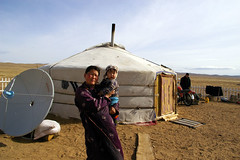
hand mangle which I helped crank. Then it went on the clothes line outside and she hoped it wouldn't rain. The damp laundry she would later festoon on a clothes horse around the small fire, usually lit in the late afternoon. In the evening, she and my grandfather would barricade themselves in the room, drawing draught-proof curtains across doors and windows and watch the TV. And what a TV! A massive wooden box with a tiny rounded black and white screen. There was only one channel: the BBC. And there were numerous 'technical faults', both with the transmission and on the set itelf which frequently went into uncontrollable rolling picture spins. But to me, it was luxury... until I was told to go to bed.Life 100 years ago: But what about a century or more ago? My grandfather, who lived to be 101, as a boy travelled about in horse-drawn omnibuses and carts, on a bicycle but mostly on foot. There were, of course, no cars and the Wright brothers hadn't yet invented powered flight. Most houses had no running water or toilets. My granny's small 1930s semi-detached house, which I remember from the late 1950s, would have seemed luxurious to people at the turn of the 19th century. And their accommodation and means of transport would have seemed likewise to people living a century earlier... and so on back to the simple huts, yurts, tepees and caves of our more distant ancestors, not forgetting that there are still plenty of people around the world who still live in that simple fashion.
Jump to 2008: Oh my, how things have changed! Today, people expect to live in permanently warm houses as a sort of obvious right. And most expect a home with 2 or more toilets,
shower rooms, bathrooms and constant hot water. Then there's the phone, a basic necessity now - if only for broadband access - but my granny didn't have one. Making a phone call from the phone box round the corner was a rare and expensive event. So we wrote letters then; a dead art today. Most rich world homes today have several TVs, often with giant screens and, via satellite (yes, I remember Sputnik 1, the first Earth satellite, back in 1957), hundreds of channels to choose from. Everyone now has some means of recording TV so you could spend your whole life watching something.And my point is? This whole flimsy house of cards depends utterly on cheap fossil fuel (see my earlier post). These Great Expectations can't go on. Obviously if you're born to all this 'stuff' -- be it cars, supermarket food, warm homes, automatic washers, DVDs, iPods, Facebook and numerous etceteras -- you're not really able to appreciate the comfort and luxury all this affords because you've never known life without. Most would say these things were basic necessities; a right; essentials.
myself. Yet a short fifty years ago, a fixed phone in a house was a luxury and not people many had them. Life went on. Today, people are in touch with friends all the time. Step back 30 years. I was working in the high Peruvian Andes for weeks at a time. I could only send a brief telegram to my wife in Lima if I happened to pass through some small town. Most of the time, she didn't know if I was alive or dead and the odd telegram she did receive a day or so after sending was often hopelessly garbled. Now jump back to the time of World War 2. I once met a former soldier who had been unable to contact his wife for over 3 years and, I gather, that wasn't unusual. Suddenly, sending a telegram every week or so seemed like regular chat!A scary dependency: So imagine the chaos if some of these 'essentials' that every younger person takes for granted today ceased to work or be available! There'd be riots in the streets; anarchy. Doomsayers like James Lovelock predict that civil consumerist societies will disintegrate when planetary heating really kicks in. How many people know basic skills like cooking or how to grow their own food? Is life possible without the Internet and mobile phones? Without cars and the fuel they need to move? Without holidays abroad? Without supermarkets and shopping?
Wednesday, February 20, 2008
What's wrong with this picture?
Wednesday, January 09, 2008
Energising renewable energy
Going slow: Why is renewable energy becoming energised so slowly in 'backward' countries like the Great Britain which is where I live? Why has it taken off in Germany? Both countries have similar climates: lots of grey skies and wind. In fact, Britain has more wind and a vast resource, as yet untouched, of wave and tide power which Germany with its limited coastline does not possess. And yet Germany is streets ahead on producing energy from renewables, principally photovoltaics. Renewable energy made up more than 14 percent of Germany's power consumption in 2007, up from almost 12 percent in 2006, with wind as the main contributor (source: The Guardian). Why Germany?Becoming energised: It seems it's all down the German government's intelligent foresight. The government guarantees a market for solar power by operating a system of feed-in tariffs. There, as explained in a New Scientist article (Solar power: The future's bright, 8 December 2007), anyone who produces electricity from solar power can sell it to the national grid for between Euros 0.45 and Euros 0.57 per kilowatt-hour, which is almost three times what consumers pay for their electricity, roughly Euros 0.19 per kilowatt-hour.
And the result? Today there are over 300,000 photovoltaic (PV) systems in Germany, mostly on the rooftops of homes and small businesses, and Germany is the world's fastest-growing PV market. It has 55 per cent of the world's installed base of PV panels and can generate around 3 gigawatts of electricity from solar energy, equivalent to between three and five conventional power stations (ibid, New Scientist). All from a country which passes much of its time under grey cloud like Britain.
The windiest European country lags badly: Great Britain could have done this for wind energy -- PV too since the amounts of solar energy received by Britain and Germany are fairly similar. It could have done it for waves and tide power but instead, it relied of cheap oil and gas from the North Sea, coal and the massively-subsidised nuclear industry.
It needn't be like this: A smart British government would follow Germany's lead -- now actively being pursued by Italy and Spain for PV -- and California is, as usual, leading the way in the USA with major subsidies for new PV installations. Britain is well placed to energise its wind power generation together with developing emerging technologies for storing the energy produced by using compressed air energy storage (CAES), perhaps utilising the vast underground caverns left by salt-mining in central-west parts of England. At present, the British government offers a derisory grant and rumour has it that even this is to be axed. So there is little incentive for someone like me to invest in a wind turbine on my windy north-west Wales farm.
NIMBY and turbulence: Quite apart from the requirement for planning consent for stand-alone turbines, there is the problem of those people who object to 'spoilt views' (it seems the numerous power pylons are okay bringing energy from a far-off polluting coal power station which is not, of course, in their back yard!) and who complain of 'possible noise' (aircraft? helicopter? cars? lorries? All okay, it seems). That is quite sufficient for a local council to reject an application for a turbine.
Turbulence is another issue and can be a serious problem around buildings and in urban areas -- which makes the new 'bolt on your wall'-type turbines a bad buy. But what about farms? Fields are open; turbines are free-standing: it's not difficult to find space on any farm of my size (5 hectares) or bigger. Farms are already host to eyesores like huge barns, stacks of silage, slurry tanks and grain silos, all acceptable to the planners. The view is already compromised.
Decentralised power stations: So imagine if every farm had a turbine or two? There are several first class turbines (like the range offered by Proven, as featured in my picture) which are tailor-made for farm use. In fact, Proven are attempting to start a new way of producing wind energy called wind crofting. There are tens of thousands of farms in windy Britain. Every farm, linked into the grid, could be electric energy-independent as well as feeding surplus power into the national grid. The wind is almost always blowing somewhere. (As I write, it's blowing a severe gale here!)
Could be? Should be and would be if there was a scheme for feed-in tariffs like Germany's. I'd be one of the first to join! Come on, British government: get your act together and stop approving coal-fired power stations on the flimsiest of pretexts (Carbon Capture and Storage -- CCS -- might perhaps someday become a reality) and tap into this massive resource of power available now, pollution-free with no decommissioning costs...
If the practical side of renewable energy interests you, keep an (RSS feed) eye on my Mur Crusto eco-farm blog because my wife and I are agreed that, notwithstanding all the difficulties and lack of assistance available, we shall try and install a 6kW Proven turbine this year. As the project proceeds, I'll be posting...
Saturday, October 27, 2007
Double good: building without cement
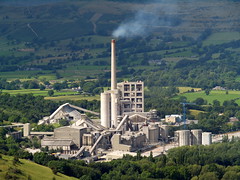
Cement is a problem Did you know that cement manufacture creates 5% of all industrial carbon dioxide emissions? That matches the pollution output of the world's aviation industry. What's more, both are set to increase, particularly in China. Construction inevitably means cement for mortar and concrete -- or does it? Certainly for the likes of high-rise city blocks, nuclear power stations and large dams, there's no alternative. But what about ordinary housing? How much concrete needs to be used in that?
Wood: a partial solution with a big bonus

Building houses out of wood is nothing new in timber-rich regions like Scandinavia and North America. Wood has many advantages over bricks, mortar, steel and concrete. For one thing, it's very easy to use so buildings can be completed in just weeks rather than months. When I 'built' my first house in western Canada back in 1971, it took 3 weeks to get the entire structure completed and watertight, ready for services to be installed. When I built my house in Spain in 1989, it took more like 6 months. Why? Because there was no wood used in my Spanish house at all, that being the local style of building. Prestressed concrete beams, which are used in large numbers, are incredibly heavy to manhandle into position or cast. So are blocks, bags of cement and making and carrying endless buckets of mortar. I worked on this house throughout the construction, so I know!
The hidden bonus of wood is that it is almost pure carbon. The growing tree grabs CO2 out of the air and converts it into sugars and, ultimately, to cellulose and lignin which is what we call wood. Everyone knows that trees sequester carbon and that they are one of several natural ecosystem services -- in this case, carbon sinks -- which counter climate change caused by humans burning fossil fuels. This is the rationale behing the burgeoning offsetting business. Plant a few trees and you can pollute as much as you want. That's what people seem to assume when guilt over squandering energy overcomes them a little.
The big issue: seeing the wood for the trees
Even if it were true that you can assuage your travel/consumer/heating/airconditioning energy use by offsets, there is one problem which seems not to enter general thinking. Natural forests are carbon neutral. As fast as young growing trees grab carbon, dead and decaying trees (and forest fires) release it again: the carbon cycle. To make sequestering carbon in trees really work to reduce atmospheric CO2, the mature trees need to be harvested and stored in such a way that they don't decompose and release all their carbon again. Carbon storage is what happened on a massive scale over hundreds of millions of years, as coal formed from dead but not decayed trees. The carbon has become safely locked away from oxidation into the atmosphere... until humans came along (and you know the rest). Yet when you think about it, we are storing carbon all the time -- in the form of timber-framed housing construction and, to a lesser extent, as books in the world's libraries.
So that's my point: countries which traditionally use cement in the form of concrete and mortar to build houses should change their construction practice and build from timber instead. This change of direction has several advantages:
- timber construction locks away carbon
- it's quicker and easier
- self-build is much easier and in some countries, you can buy housing kits to do this
- it is essentially non-polluting unlike cement-based constructions which cause massive CO2 releases into the air, principally from cement quarrying and manufacture
- if real environmental costs are taken into account, wood is far cheaper
- greater demand for timber would stimulate more forestry development with yet more sequestration of carbon as a bonus. At the same time, cement manufacture would decline as demand slackened off, so reducing carbon pollution
- timber can be re-used
- timber-framed buildings are intrinsically warmer than stone, brick, block and concrete. In addition, it is simple to incorporate insulation in the timber frame
- wood is a pleasant material to work with and beautiful to look at. Concrete is messy and heavy to move around
Yes I know concrete is essential for many purposes, including the foundations (footings) of timber-framed housing. My point is simply that we could use a lot less of it -- a lot less -- if we wanted to.
Tuesday, October 09, 2007
The Future of Nuclear Power

Today is the final day for anyone to make their views known about future nuclear power in the UK. I've done this on the British Government's Future of Nuclear Power website. Just to put you in the picture, I have argued for some time that, if we are to have new nuclear power stations, they should be built underground.
Here are my responses to the Government's consultation questions:
1. Safety and security of nuclear power
Siting all future nuclear plants underground is something that should be taken very seriously. This does not even seem to have been considered. Yet it has three major advantages:
- immune to military attack from the air
- containment unbreachable (given proper choice of ground conditions, hydrogeology and rock types) and so immune to attack from, say, a suicide bomber. Even major LOCAs would be better contained than anything above ground
- no need ever to remove irradiated fuel assemblies. When the reactor reaches the end of its operating lifetime, the whole facility could be sealed, complete with its spent fuel. Monitoring would be needed but because nothing is above ground, access would only be minimal. Decommissioning surface plants is turning out to be formidably expensive and all radioactive materials end up having to be sealed underground anyway in all viable scenarios
2. Transport of nuclear materials: No reprocessing is the right route, but by siting each nuclear plant underground, there would be no need for the spent fuel ever to leave the facility. It would be stored there in a facility built at the same time as the reactor containment cavern. When the reactor's life is over, both it and the spent fuel stored close by would be made safe, sealed and remotely monitored. No radioactive materials, highly active or otherwise, need ever be transported on the surface.
3. Waste and decommissioning: Locating new reactors underground would avoid many of the serious problems of waste and dceommissioning. At the end of the reactor's life, all its fuel remains in the store which would have been constructed during the initial cavern excavations and the whole underground site becomes a remotely-monitored facility with little further need for maintenance. Such an arrangement is inherently safer than a surface reactor which will need to be guarded and monitored through at least three human generations before it can be finally removed: not a good legacy for future generations.
4. Environmental impacts of nuclear power: If the nuclear facility was largely located underground, the surface footprint of a site would be markedly less than at present, quite apart from the safety aspect which I've already dealt with. There would be no need for a secondary containment structure since this would be provided by suitably geo-engineered natural rock in the excavated cavern. Surface buildings could all be part of the non-radioactive secondary circuits. So the heat exchangers containing the pipework for the primary circulating coolant would be underground but the high pressure steam circuit for the turbo-generators could be ducted to the surface which is where generators, transformers, cooling and other facilities would be located.
Regarding the space occupied by a nuclear facility versus that occupied by a windfarm, I have two comments:
- most future windfarms should anyway be located offshore, so space and NIMBYism is largely irrelevant
- any space occupied by a windfarm remains relatively pristine. If needed, turbines and supports can be completely removed within months, leaving the site uncontaminated and as it was before. The same cannot be said of surface nuclear build because of the massive largely concrete bioshielding infrastructure required and the problem of the 'hot' reactor core which cannot be removed for over 100 years, or requires prohibitively expensive and hazardous remote-controlled decommissioning and transport of large quantities of medium level radioactive waste to a repository as yet not in existence. These 'inconvenient truths' are a prime reason why nuclear build should in future be underground.
5. Reprocessing of spent fuel: I agree that reprocessing should not be carried out. Storage for spent fuel assemblies should be 'built in' in the underground location scenario I envisage. This eliminates the need for surface transport of highly active fuel rods.
Obviously these remarks apply to any new nuclear build anywhere on the planet, not just the UK! At the very least, I think the onus should be on governments and the energy industry to explain why siting nuclear plants underground is NOT a good idea (if it isn't!). But I expect it will be ignored... ho hum!